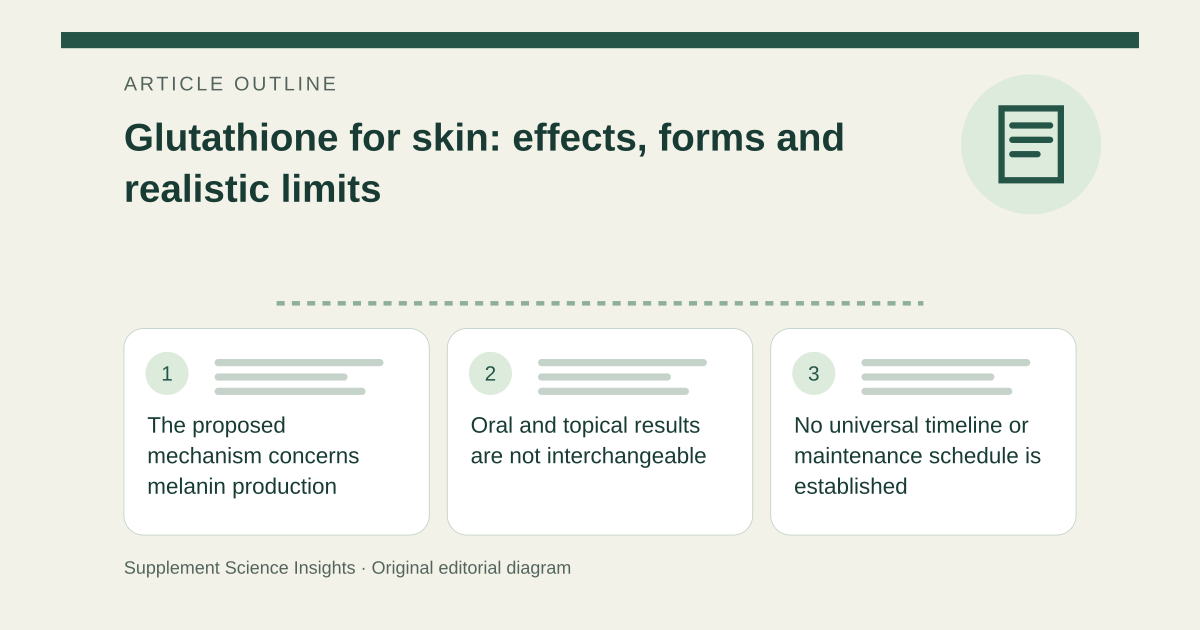
The proposed mechanism concerns melanin production
A review describes effects on tyrosinase and a shift in pigment production from eumelanin toward pheomelanin. These mechanisms explain research interest, but they do not predict how many shades a person will change or establish that changing natural skin color is medically necessary. [1]
Oral and topical results are not interchangeable
A 2025 systematic review found signals for oral and topical approaches, but study quality was mixed and effects were not reliably sustained. Local application and systemic exposure answer different questions; improvement in a melanin index is not proof of broad skin rejuvenation or permanent treatment of melasma. [2]
No universal timeline or maintenance schedule is established
Treatment duration, formulation, body site and individual response differ. The reviews identify unresolved questions about how long any effect lasts and how maintenance should work. An advertisement promising a fixed number of sessions or permanent results goes beyond this evidence. [1][2]
Choose diagnosis and safety before a stronger route
Imagine a person with persistent pigmentation is offered an IV package after a topical product disappoints. Seek dermatology assessment rather than assuming injection is better. Current FDA and CDC contamination warnings add a concrete reason to scrutinize compounded glutathione, independent of uncertain cosmetic benefit. [3][4]
| Claim | Limit |
|---|---|
| Melanin mechanism | Does not predict shades |
| Topical response | Not systemic evidence |
| Permanent lightening | Durability uncertain |
| Faster IV results | No validated shortcut |
Sources for this article
- Glutathione as a skin whitening agent: Facts, myths, evidence and controversies.
Source consulted: 2026-09-21. This is a reference resource, not a claim that we conducted the studies or tested a product. - Glutathione as a skin-lightening agent and in melasma: a systematic review.
Source consulted: 2026-09-21. This is a reference resource, not a claim that we conducted the studies or tested a product. - FDA reminds compounders not to use dietary supplement grade glutathione for injectables | FDA
Source consulted: 2026-09-21. This is a reference resource, not a claim that we conducted the studies or tested a product. - Adverse Events Linked to Injectable Glutathione Compounded with Dietary Supplement Grade Ingredient: Current Situation | HAIs | CDC
Source consulted: 2026-09-21. This is a reference resource, not a claim that we conducted the studies or tested a product.