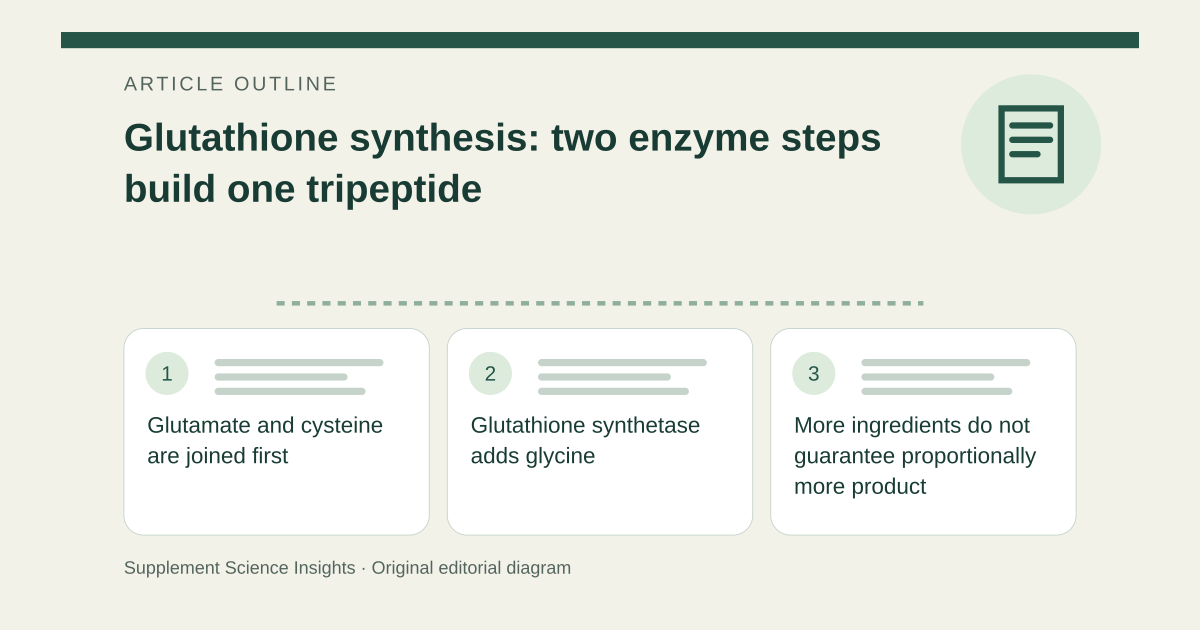
Glutamate and cysteine are joined first
Glutamate–cysteine ligase, abbreviated GCL, catalyzes the first step. It joins glutamate to cysteine to form gamma-glutamylcysteine. This reaction requires ATP, the energy-carrying molecule used in many cellular processes. [1][2]
GCL is commonly the rate-limiting step in the pathway. In mammals it has a catalytic subunit and a modifier subunit. The modifier affects how efficiently the enzyme operates; it is not an additional amino-acid ingredient in the final glutathione molecule. [1][2]
Glutathione synthetase adds glycine
The second enzyme, glutathione synthetase, adds glycine to the intermediate, also using ATP. The resulting molecule contains glutamate, cysteine and glycine. The GSS gene encodes this second enzyme. [1][2]
This is enzymatic synthesis in cells, not the ordinary ribosomal process that translates an mRNA sequence into a protein. Listing the three building blocks therefore does not fully describe the machinery needed to make glutathione. [1][2]
More ingredients do not guarantee proportionally more product
Glutathione can inhibit GCL through feedback, and cysteine availability helps influence the first reaction. Regulation means that doubling an ingredient does not imply doubling the final cellular pool. Production also interacts with use, recycling and export. [1][2]
These pathway facts explain why precursor studies are biologically plausible. They do not establish a universal precursor dose, a need for supplementation or equivalence between a precursor blend and glutathione itself. [1][2]
Separate the first intermediate from the final product
Imagine the first reaction proceeds but the second enzyme is impaired. Having the intermediate available would not make the two-step process complete. This illustrates why both enzymes matter, rather than diagnosing a nutritional deficiency.
| Observation | What it means |
|---|---|
| GCL plus ATP | Forms gamma-glutamylcysteine |
| Synthetase plus ATP | Adds glycine |
| Feedback and substrate supply | Help regulate output |
Sources for this article
- Lu: Glutathione synthesis — foundational mechanistic review
Source consulted: 2026-09-17. This is a reference resource, not a claim that we conducted the studies or tested a product. - MedlinePlus Genetics: GSS
Source consulted: 2026-09-17. This is a reference resource, not a claim that we conducted the studies or tested a product.