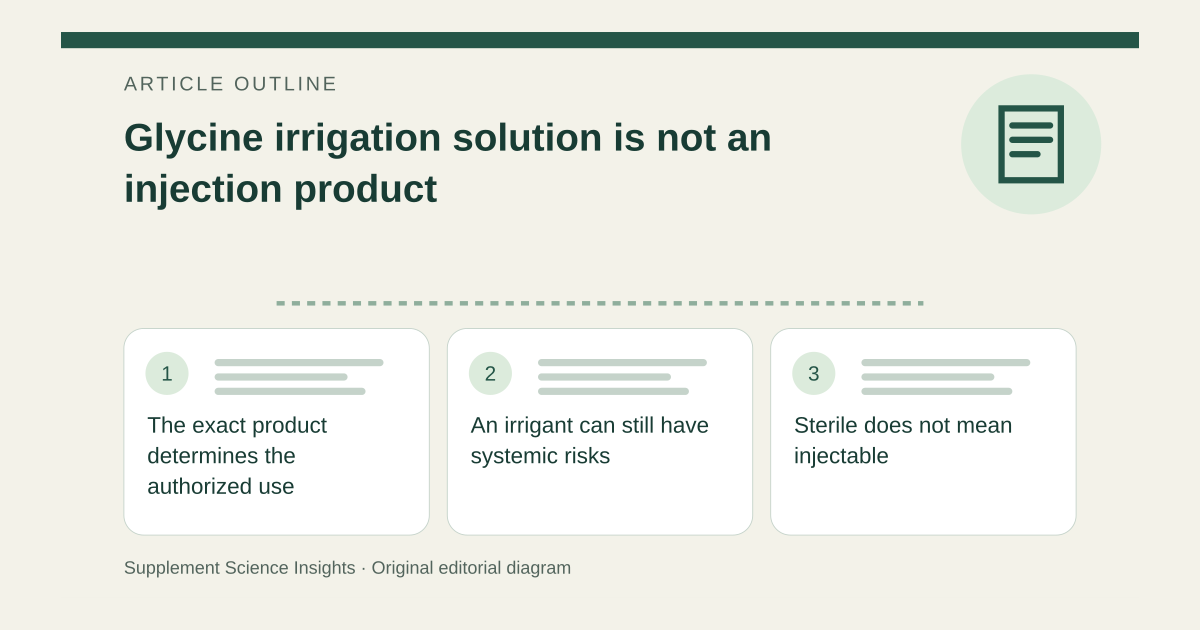
The exact product determines the authorized use
The DailyMed label identifies 1.5% Glycine Irrigation USP as an irrigant during transurethral prostate or bladder surgery. It is administered using the appropriate surgical instrumentation, not injected because its ingredient is an amino acid. [1]
This page addresses that specific irrigation preparation. It is not a statement that every medically formulated amino-acid product has the same route or indication. [1]
An irrigant can still have systemic risks
The label warns that fluid absorbed during surgery can affect fluid and electrolyte balance, including causing hyponatremia with substantial absorption. Cardiopulmonary and renal status matter. [1]
Those warnings reinforce why route, concentration and clinical setting are part of the product identity. A familiar nutrient name does not make a surgical preparation suitable for wellness injection or self-administration. [1]
Sterile does not mean injectable
Imagine a container is sterile and contains glycine. That information alone does not establish an injection use. The explicit irrigation labeling and prohibition on injection govern this preparation.
| Detail | Interpretation |
|---|---|
| 1.5% irrigation product | Surgical irrigant |
| Sterile packaging | Does not authorize injection |
| Systemic absorption | Can create clinical risks |
Sources for this article
- DailyMed - GLYCINE irrigant
Source consulted: 2026-09-17. This is a reference resource, not a claim that we conducted the studies or tested a product.