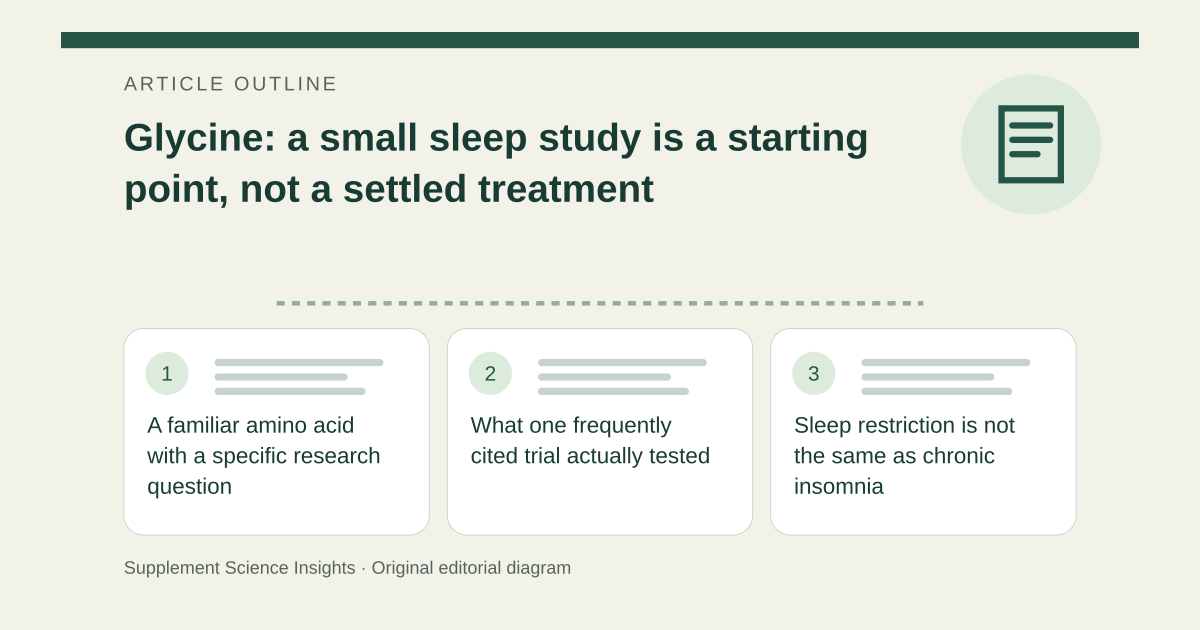
A familiar amino acid with a specific research question
Glycine is a nonessential amino acid studied for sleep-related outcomes. A product containing glycine alone is different from magnesium glycinate or a multi-ingredient sleep blend. Similar names should not make those interventions interchangeable.
The practical question is not merely whether glycine participates in normal biology. It is whether a defined supplemental preparation improves a meaningful sleep or daytime outcome, compared with an appropriate control, in people whose situation resembles the reader's.
What one frequently cited trial actually tested
A 2012 randomized, single-blind crossover trial enrolled ten healthy male Ajinomoto employees; seven were analyzed. Participants received 3 g glycine or a flavored placebo before bed during three nights with time in bed reduced by 25 percent. They did not have diagnosed sleep disorders. [1]
Some fatigue and vigilance findings were favorable, while other tests were not clearly different. Several authors had company affiliations; the paper declared no conflicting commercial or financial relationships. Its small, short, industry-connected sample limits generalization. This is a description of the study, not a dose recommendation. [1]
Sleep restriction is not the same as chronic insomnia
People deliberately spending less time in bed are not necessarily representative of people unable to sleep despite an adequate opportunity. A finding in the first group cannot establish treatment for the second. The problem definition belongs beside the result.
The study also does not establish that a supplement makes restricted sleep harmless. A vigilance-test change cannot replace an assessment of broader health, work or driving outcomes. Those outcomes would require direct evidence rather than extrapolation from one short laboratory-style task.
A seven-person analysis cannot settle long-term safety
The study's size and duration cannot establish uncommon adverse effects, long-term safety or suitability during pregnancy, childhood or complex medical treatment. These are limits of the evidence, not claims that a particular harm occurred. [1][2]
NCCIH advises discussing supplements and medicines with the care team and cautions against substituting supplements for established care. For a sleep blend, record all ingredients and amounts. This page does not provide a bedtime regimen or suggest that increasing exposure resolves an inadequate response. [1][2]
Glycine versus L-theanine for sleep
The studies discussed here do not establish a winner between glycine and L-theanine. The glycine pilot analyzed seven healthy people during short-term partial sleep restriction and found mixed improvements in next-day measures. A separate L-theanine crossover trial followed 30 adults without major psychiatric illness for four-week treatment periods and found improvements in some self-reported sleep subscales versus placebo. [3][4][5]
They were not head-to-head trials, used different outcomes and had industry connections. Those differences prevent a reliable claim that one works faster, prevents more night waking or causes less grogginess than the other. Neither result establishes either supplement as a replacement for assessment and evidence-based care for persistent insomnia. [3][4][5]
Report the analyzed denominator
Imagine a fictional report advertises ten participants enrolled, but only seven contribute to the final analysis. Both numbers matter. The evidence does not become a ten-person analysis simply because enrollment began there.
A useful summary also states why participants were excluded and whether exclusions could influence results. This numerical example illustrates study reporting rather than a benefit estimate or a claim that every exclusion creates bias.
| Hypothetical study count | Interpretation |
|---|---|
| 10 enrolled | Starting sample |
| 7 analyzed | Outcome denominator |
| Short experimental restriction | Not a chronic-insomnia trial |
Promising signals need larger independent confirmation
This overview does not recommend glycine for chronic insomnia. It uses a concrete study to show why design, population, exclusions and mixed endpoints matter. A positive result can justify further research without establishing a dependable treatment for a much broader group.
Sources for this article
- Bannai et al. (2012) — Glycine during partial sleep restriction
Source consulted: 2026-09-17. This is a reference resource, not a claim that we conducted the studies or tested a product. - NCCIH — Using dietary supplements wisely
Source consulted: 2026-09-17. This is a reference resource, not a claim that we conducted the studies or tested a product. - Bannai et al. 2012: Glycine and daytime performance during partial sleep restriction
Source consulted: 2026-09-25. This is a reference resource, not a claim that we conducted the studies or tested a product. - Hidese et al. 2019: L-theanine, stress-related symptoms and cognition, randomized crossover trial
Source consulted: 2026-09-25. This is a reference resource, not a claim that we conducted the studies or tested a product. - NCCIH: Sleep disorders and complementary health approaches
Source consulted: 2026-09-25. This is a reference resource, not a claim that we conducted the studies or tested a product.