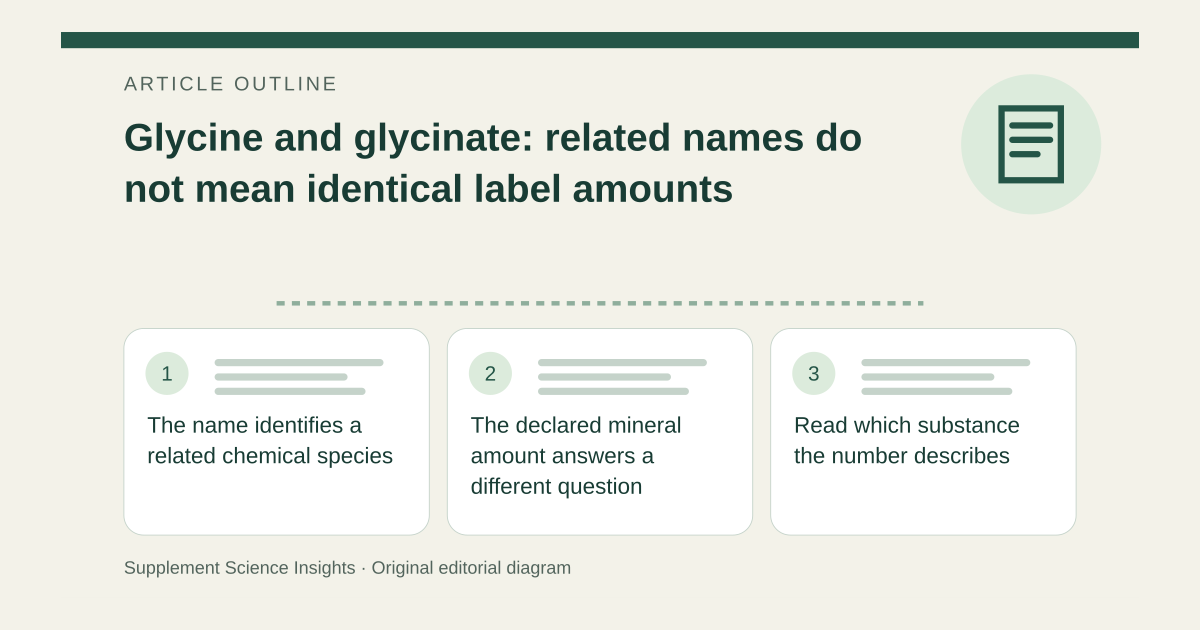
The name identifies a related chemical species
ChEBI classifies glycinate as an amino-acid anion with a net charge of minus one and identifies glycine as its conjugate acid. These are related acid–base forms, not names for an unrelated nutrient. [1]
Chemical notation describes a species under a defined representation. It should not be interpreted as a promise that every glycine-containing preparation behaves identically in the body. [1]
The declared mineral amount answers a different question
On a magnesium supplement, the Supplement Facts magnesium amount is the elemental mineral amount, not the weight of the entire associated compound. It is therefore not a direct statement of how many grams of free glycine are being consumed. [2][1]
Do not borrow a dose or outcome from a glycine study merely because glycinate appears in a mineral ingredient name. The preparation and amount would need to match the evidence. [2][1]
Read which substance the number describes
Imagine a label declares 100 mg magnesium from a glycinate form. The 100 mg describes magnesium; it should not be relabeled as 100 mg glycine or as the total compound weight.
| Detail | Interpretation |
|---|---|
| Glycinate | Glycine-related anion |
| Elemental magnesium | Mineral amount |
| Free-glycine study | Different exposure |
Sources for this article
- glycinate (CHEBI:32508)
Source consulted: 2026-09-17. This is a reference resource, not a claim that we conducted the studies or tested a product. - Magnesium - Health Professional Fact Sheet
Source consulted: 2026-09-17. This is a reference resource, not a claim that we conducted the studies or tested a product.