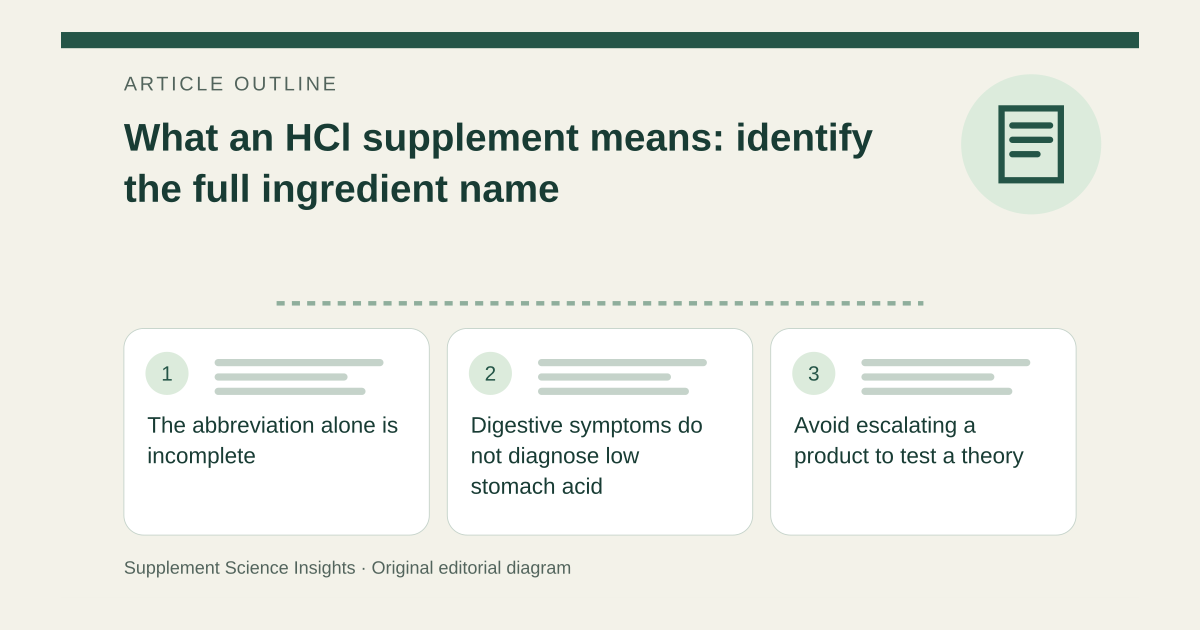
The abbreviation alone is incomplete
Betaine hydrochloride is discussed as a stomach-acidifying ingredient, while betaine also appears in other nutritional contexts. Do not treat every ingredient ending in hydrochloride as the same digestive product. The full name, formulation and intended use are needed to understand the label. [1][2]
Digestive symptoms do not diagnose low stomach acid
Bloating or discomfort can have multiple causes. Cleveland Clinic describes clinical evaluation of suspected hypochlorhydria and treatment directed at the cause. In the United States, the stomach-acidifier regulation states that adequate data are lacking to establish these OTC acidifier products as generally recognized as safe and effective for that use. Retail availability is not proof of an approved treatment. [2][1]
Avoid escalating a product to test a theory
Imagine someone assumes reflux means too little acid and increases betaine HCl until it burns. That is not a reliable diagnostic method. Discuss persistent symptoms and medicines with a clinician instead of using a self-directed acid challenge or treating burning as the desired endpoint. [2][1]
| Name or claim | What it means |
|---|---|
| HCl abbreviation | Read the complete ingredient |
| Betaine hydrochloride | Not the same formulation as betaine anhydrous |
| Digestive symptoms | Need cause-specific assessment |
Sources for this article
- 21 CFR § 310.540 - Drug products containing active ingredients offered over-the-counter (OTC) for use as stomach acidifiers. | Electronic Code of Federal Regulations (e-CFR) | US Law | LII / Legal Information Institute
Source consulted: 2026-09-20. This is a reference resource, not a claim that we conducted the studies or tested a product. - Hypochlorhydria (Low Stomach Acid): Symptoms, Tests, Treatment
Source consulted: 2026-09-20. This is a reference resource, not a claim that we conducted the studies or tested a product.