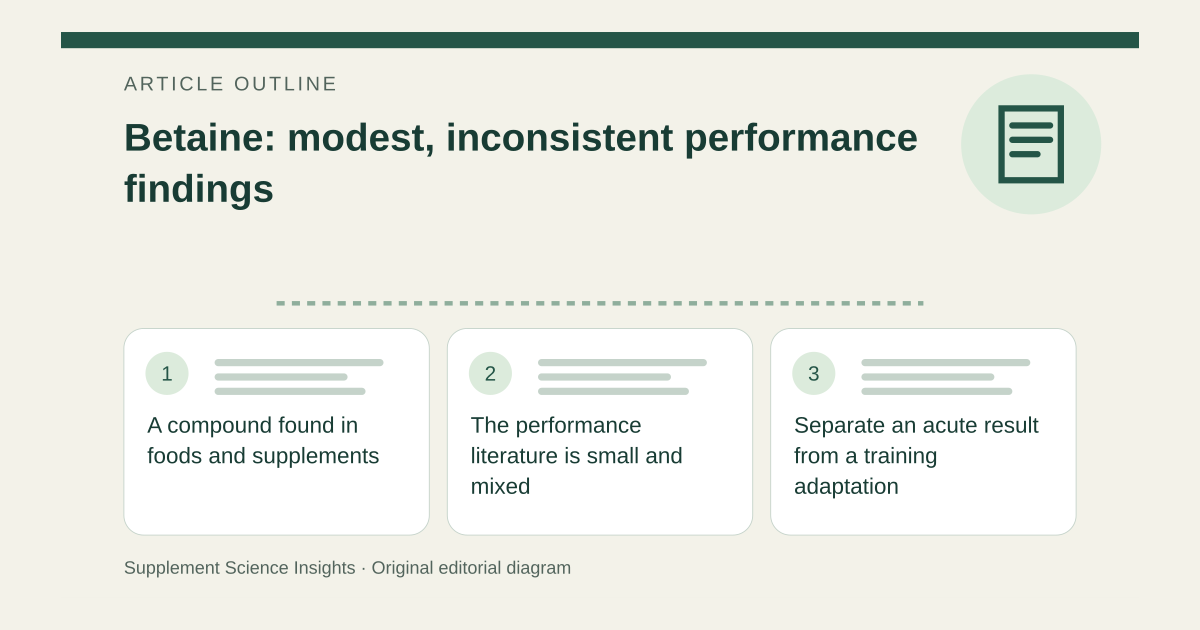
A compound found in foods and supplements
Betaine is also called trimethylglycine and occurs in foods such as beets, spinach and whole grains. It is studied in sports nutrition because of proposed effects on cellular hydration and metabolic pathways. [1]
A shared name does not establish that every commercial preparation was tested for the same purpose. Record the exact form and amount in the study and the product. A digestive product and a sports formulation should not automatically share a performance claim just because both mention betaine. [1]
The performance literature is small and mixed
NIH ODS describes limited small studies, largely in men, with inconsistent findings. Where strength or power effects appeared, they tended to be modest. This does not establish a dependable improvement across sports or training populations. [1]
A proposed mechanism involving creatine production, nitric-oxide biology or water retention cannot supply a missing performance result. The exercise protocol, study duration and actual endpoint determine whether a finding is relevant to the reader's goal. [1]
Separate an acute result from a training adaptation
A test after a short period of supplementation may measure a single bout of exercise. Increased muscle size or sustained strength gain over months is a different question. One should not be inferred from the other without follow-up.
Check whether participants followed the same training and diet and whether other supplements were allowed. If several changes occurred together, attribution becomes more difficult. Also distinguish peak power, average power and total work: a favorable result in one may coexist with no change in the others.
Short studies provide a limited safety window
Small sports studies summarized by ODS did not identify clear safety concerns in their tested settings, but the safety evidence is not comprehensive. The absence of events in a short study cannot establish long-term safety for every preparation or population. [1]
Discuss use with a qualified professional when medicines or medical conditions are involved. A multi-ingredient product needs a full-formula assessment. This page does not prescribe a serving or suggest increasing intake to overcome an uncertain or absent effect. [1]
Report peak power and total work separately
Imagine a fictional cycling test finds a higher peak power for a few seconds but unchanged total work over the full session. An accurate summary reports the brief peak result and the unchanged session result.
Calling that improved endurance would introduce a different outcome. The example demonstrates why a broad performance label is less informative than the exact measurement and its duration.
| Hypothetical result | Supported description |
|---|---|
| Peak power increased | Brief maximum-output change |
| Total work unchanged | No measured session-volume gain |
| Endurance claim | Different endpoint |
The relevant question is specific, not simply athletic
This overview does not recommend betaine as a universal strength or endurance aid. Its proposed mechanisms are reasons to study it, while practical benefit needs direct evidence. Keep the form, participant training level and measured outcome together when comparing a claim with a study.
Sources for this article
- NIH ODS — Exercise and athletic performance: professional fact sheet
Source consulted: 2026-09-17. This is a reference resource, not a claim that we conducted the studies or tested a product.