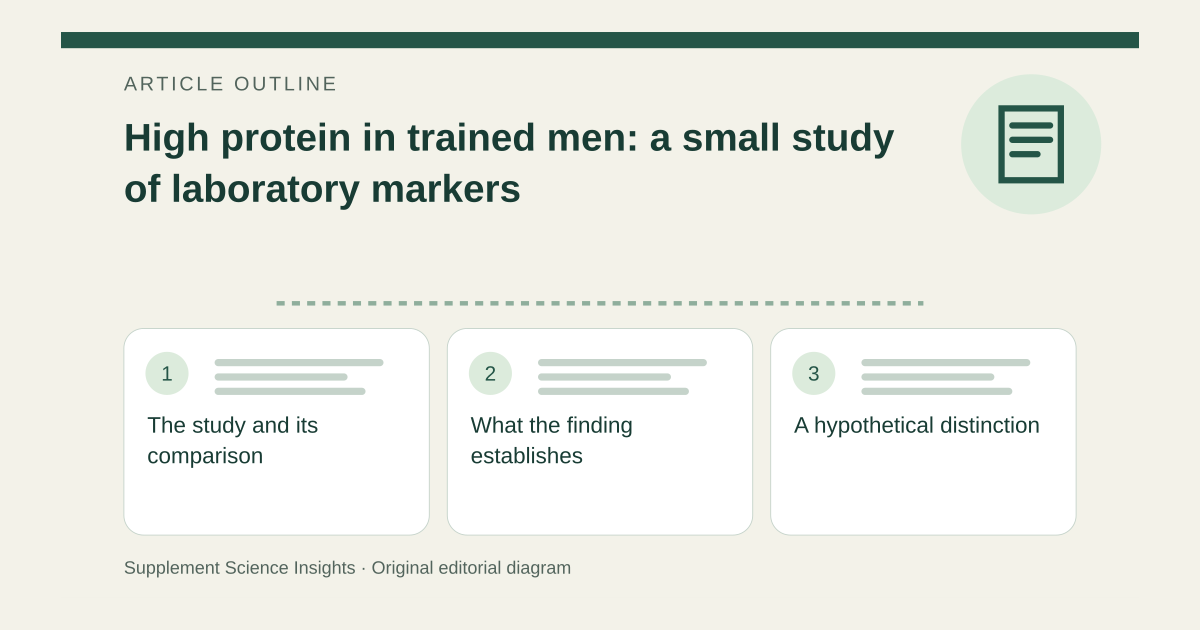
The study and its comparison
Fourteen healthy resistance-trained men completed a year-long crossover study. They spent six months on their habitual higher-protein diet and six months on a still higher intake, averaging about 2.51 and 3.32 grams per kilogram daily respectively. [1]
Selected kidney, liver and lipid measurements did not show adverse effects during the higher-intake condition. The study did not expose every participant to that condition for a full year. [1]
What the finding establishes
A small sample of healthy men cannot rule out rare harms or answer questions about chronic kidney disease. Laboratory markers are not every possible clinical outcome. Dymatize supplied protein; an author led the ISSN, which listed Dymatize as a sponsor. Other authors declared no conflicts. [1]
A hypothetical distinction
Imagine a one-year crossover contains two six-month conditions. Calling either condition a full year of exposure overstates the design.
| Detail | Interpretation |
|---|---|
| Measured outcome | Keep the endpoint specific |
| Study preparation | Not every retail product |
| Remaining uncertainty | Not resolved by a mechanism |
Sources for this article
- A High Protein Diet Has No Harmful Effects: A One-Year Crossover Study in Resistance-Trained Males - PMC
Source consulted: 2026-09-19. This is a reference resource, not a claim that we conducted the studies or tested a product.