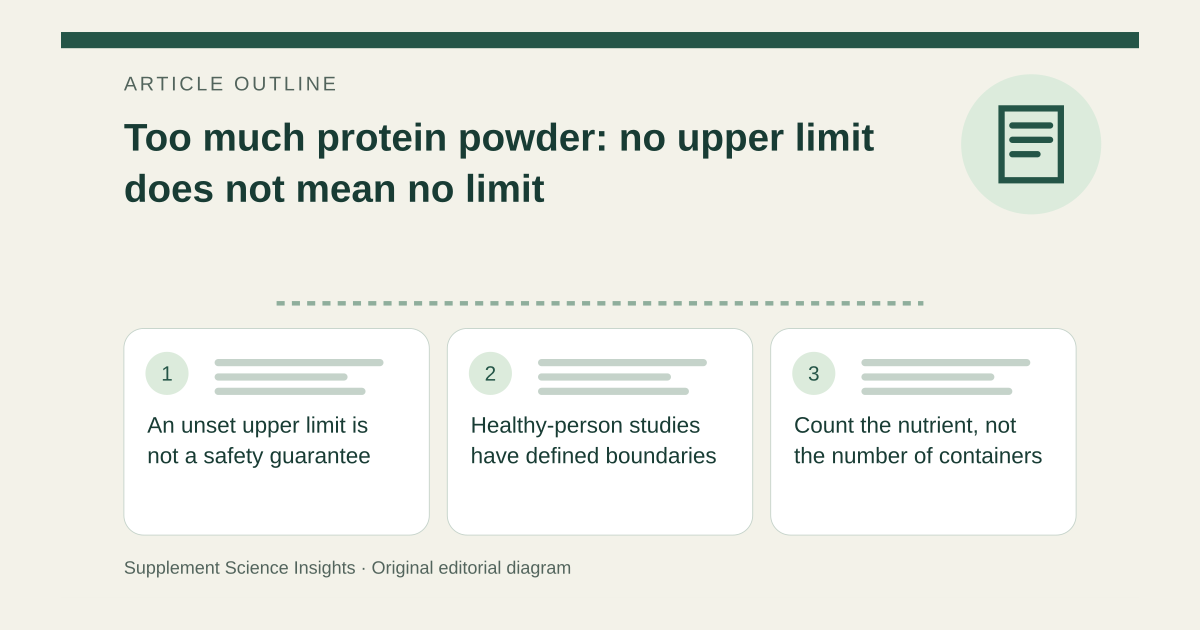
An unset upper limit is not a safety guarantee
ODS reports that the Food and Nutrition Board has not established a tolerable upper intake level for protein. It also advises caution about high intakes because data on potential adverse effects are limited. [1]
The absence of a numerical ceiling therefore cannot establish that any quantity is safe, useful or appropriate for every person. A recommended intake and an upper-limit assessment answer different questions. [1]
Healthy-person studies have defined boundaries
The ODS discussion describes reassuring findings for several high-protein diets in studied populations and time periods. Those findings should not be converted into universal lifelong safety or into advice for existing kidney disease. [1]
A prescription for a medical diet takes precedence over assumptions drawn from healthy exercising adults. Total food and supplemental protein both matter when reviewing intake. [1]
Count the nutrient, not the number of containers
Imagine someone uses a protein shake, a protein bar and a second powder while describing their intake as one supplement a day. Product categories do not capture the total protein exposure.
Recording grams from all sources produces a more useful review. It still does not set an individual maximum or establish that a symptom is caused by protein.
| Detail | Meaning |
|---|---|
| No formal UL | No established numerical ceiling |
| A studied high intake was tolerated | Evidence for that study context |
| Unlimited intake is safe | Does not follow |
More is not automatically more effective
Adequate protein supports training adaptation, but that normal role does not imply that continually increasing intake produces proportional muscle gains. The overall diet and training comparison remain important. [1]
Discuss unusually high intake or an existing medical condition with an appropriate clinician or dietitian. This page does not invent a universal scoop ceiling where the evidence does not supply one. [1]
Sources for this article
- NIH ODS: Dietary Supplements for Exercise and Athletic Performance
Source consulted: 2026-09-17. This is a reference resource, not a claim that we conducted the studies or tested a product.