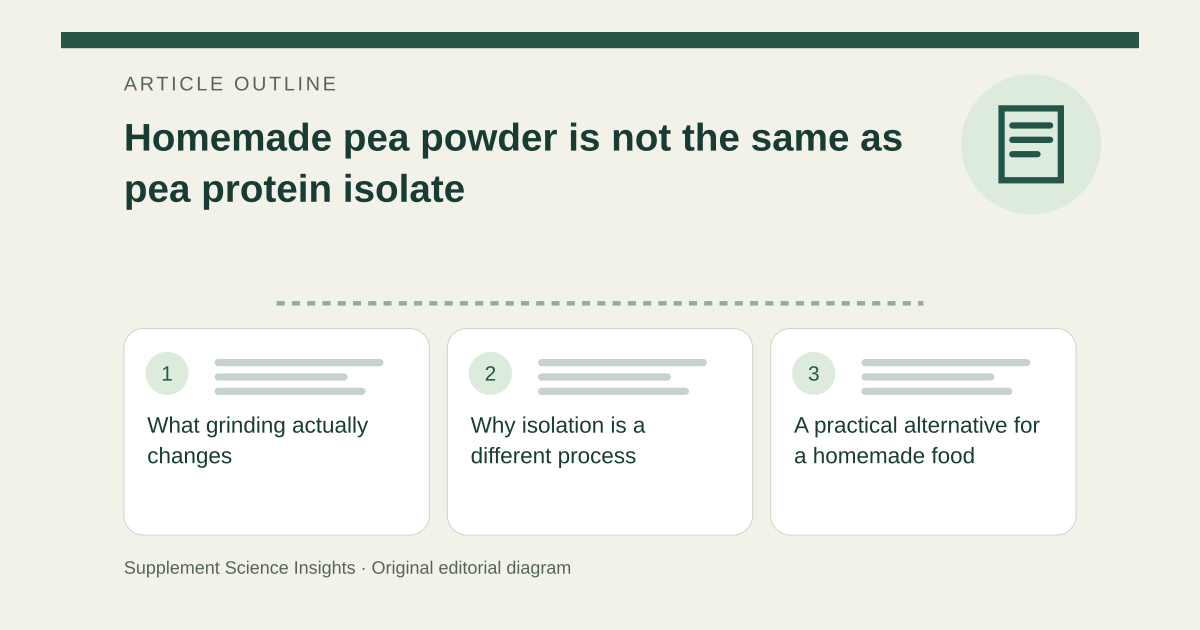
What grinding actually changes
A manufacturer’s FDA-filed notice describes pea flour as a mixture of protein, starch, fiber, sugar and fat. Grinding changes particle size without selectively removing the nonprotein material. Calling that flour protein isolate would misdescribe the ingredient, and it cannot inherit the protein percentage printed on an unrelated commercial isolate. [1]
Why isolation is a different process
The submitted process uses water, separation, controlled precipitation, purification, heat treatment and drying. This is the manufacturer’s description for one ingredient, not a universal process or FDA endorsement of muscle-gain claims. It should not be turned into a home chemical-extraction recipe or an assumption that raw flour is appropriate for an uncooked shake. [1]
A practical alternative for a homemade food
For a home protein-containing meal, use peas prepared according to food cooking directions, or combine suitable ready-to-eat ingredients in a snack. If you need a concentrated powder, compare a food-grade product’s label rather than estimating isolate content from ground peas. Muscle gain still depends on training and sufficient overall nutrition, not on whether a powder is homemade. [2][1]
| Hypothetical process | What it produces |
|---|---|
| Grinding whole dried peas | Flour; not selective protein isolation |
| Controlled industrial separation | A specified concentrated ingredient |
| Homemade meal with cooked peas | Food whose whole nutrient profile matters |
Sources for this article
- GRAS Notice 851, Pea protein
Source consulted: 2026-09-20. This is a reference resource, not a claim that we conducted the studies or tested a product. - Dietary Supplements for Exercise and Athletic Performance - Health Professional Fact Sheet
Source consulted: 2026-09-20. This is a reference resource, not a claim that we conducted the studies or tested a product.