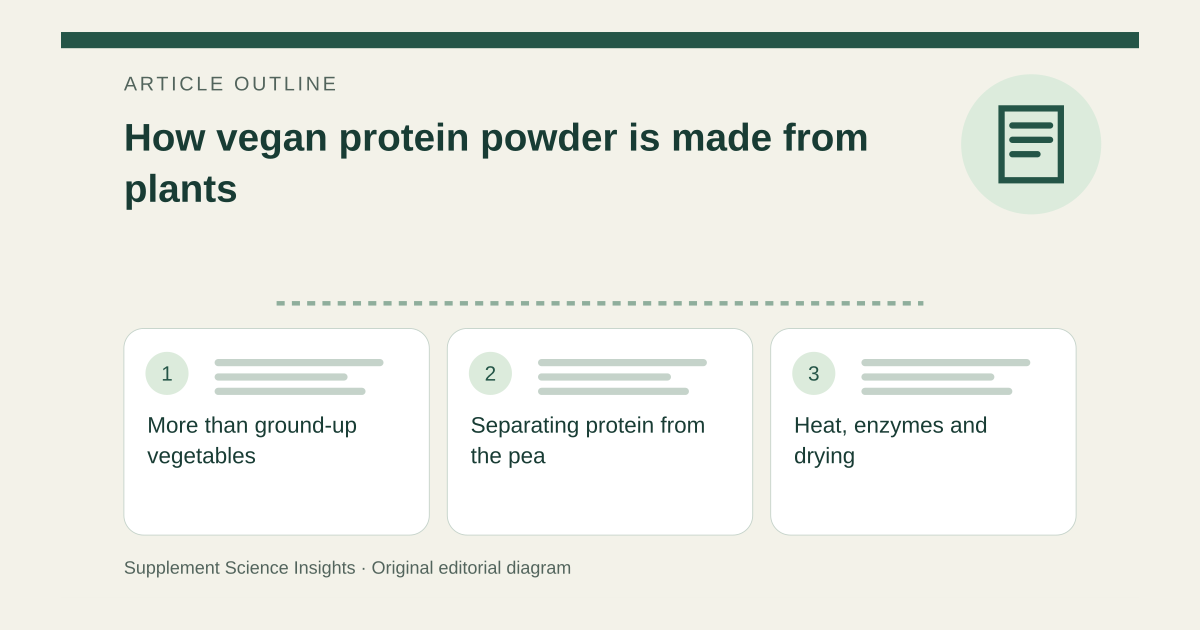
More than ground-up vegetables
A plant protein powder can be a milled food, a protein concentrate or an isolate. These descriptions matter because simply grinding a plant preserves a different mixture from separating much of its starch, fiber and other components. A protein isolate is made to concentrate protein, not reproduce the original food in miniature. [1]
A manufacturer notice for pea protein isolate hosted by FDA provides a concrete example. It describes an ingredient made from dry yellow peas. This process is specific to the described ingredient; soy, rice, hemp and other plant powders need not follow every same step. [1]
Separating protein from the pea
The documented process starts with cleaning and grinding peas and removing hull material. Water is added to the flour, and starch and fiber are separated. Adjusting conditions to the protein's isoelectric point reduces its solubility so that protein-rich material can be collected. [1]
The material is then purified and returned toward neutral pH. This illustrates an important distinction: concentration changes the proportions of components already present in the food. A scoop of isolate therefore cannot be assumed to provide the fiber, carbohydrate and micronutrient pattern of a serving of whole peas. [1]
Heat, enzymes and drying
In this particular process, heat treatment is used for microbial reduction. Food-grade protease enzymes also break some peptide bonds to change functional properties, including viscosity. The enzymes are subsequently inactivated by heat before spray drying. The resulting dry ingredient passes through additional handling and metal-detection controls. [1]
Not every vegan powder is enzymatically hydrolyzed. “Plant based,” “isolate” and “hydrolyzed” answer different questions: origin, degree of separation and whether proteins have been cut into smaller pieces. None of those terms alone measures the performance of the finished powder in a person's diet. [1]
Following a hypothetical scoop
Consider an unflavored pea isolate that is later blended with cocoa and sweetener. The finished scoop contains the isolate plus those added ingredients, so its total weight is not all protein. Read the finished product's protein amount and ingredient list rather than applying the ingredient manufacturer's composition directly to the entire flavored blend. [1]
| Stage | What changes |
|---|---|
| Milling | Particle size and removal of hull material |
| Separation | Relative amounts of protein, starch and fiber |
| Drying and formulation | Water content and final ingredient mixture |
Sources for this article
- GRAS Notice 851, Pea protein
Source consulted: 2026-09-20. This is a reference resource, not a claim that we conducted the studies or tested a product.