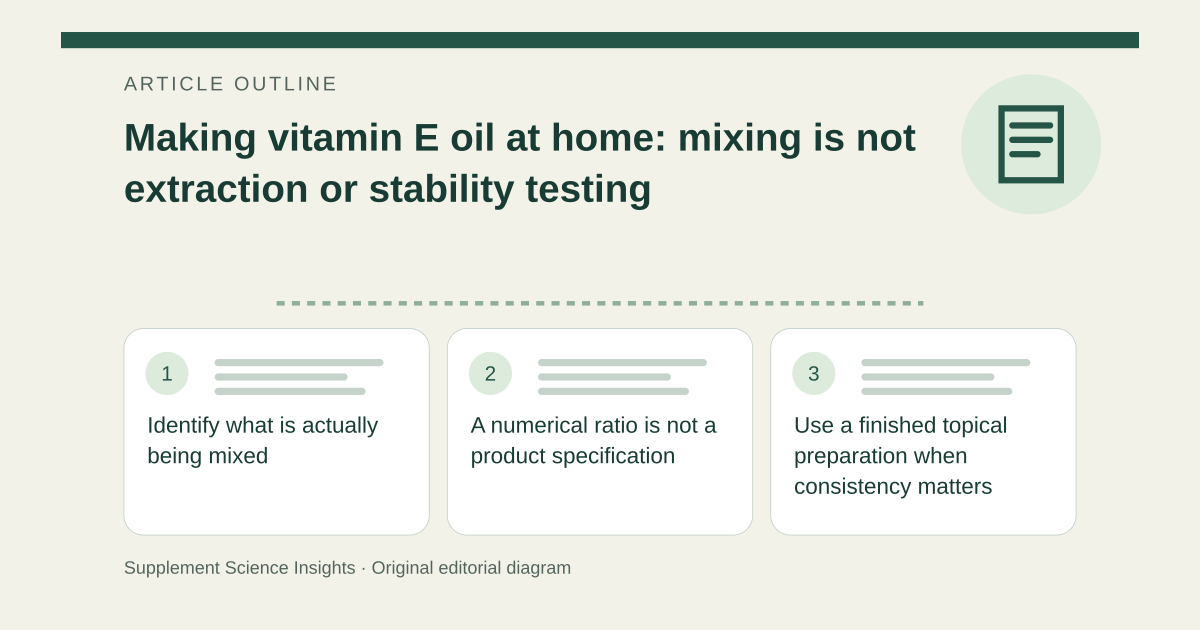
Identify what is actually being mixed
An oral supplement capsule and a cosmetic ingredient are designed for different uses. Concentrations and other ingredients can vary. A capsule count alone does not describe the concentration of a finished skin product, and transferring an oral dose onto the skin does not establish topical effectiveness. [1][2]
A numerical ratio is not a product specification
Even a carefully measured mixture needs an appropriate intended use, ingredient compatibility and handling plan. FDA describes how contamination can arise from raw materials, manufacturing, packaging and consumer handling. Adding water or fresh plant material also changes the formulation; an oil-only assumption should not be carried into a gel or emulsion. [3]
Use a finished topical preparation when consistency matters
Imagine two supplement capsules contain different strengths and carrier ingredients. Adding each to the same spoonful of oil produces different mixtures. For routine skin care, a formulated product with directions offers a defined starting point; test new products on a small area and stop if they cause a reaction. No hair-growth, scar-removal or preservation claim follows from the homemade mixture itself. [2][4]
| Situation | What it means |
|---|---|
| Capsule count | Not a complete concentration specification |
| Added water or plant material | Changes the formulation |
| Freshly mixed | Not the same as tested stability |
Sources for this article
- Dietary Supplements: What You Need to Know
Source consulted: 2026-09-20. This is a reference resource, not a claim that we conducted the studies or tested a product. - How to test skin care products
Source consulted: 2026-09-20. This is a reference resource, not a claim that we conducted the studies or tested a product. - Microbiological Safety and Cosmetics | FDA
Source consulted: 2026-09-20. This is a reference resource, not a claim that we conducted the studies or tested a product. - Shelf Life and Expiration Dating of Cosmetics | FDA
Source consulted: 2026-09-20. This is a reference resource, not a claim that we conducted the studies or tested a product.