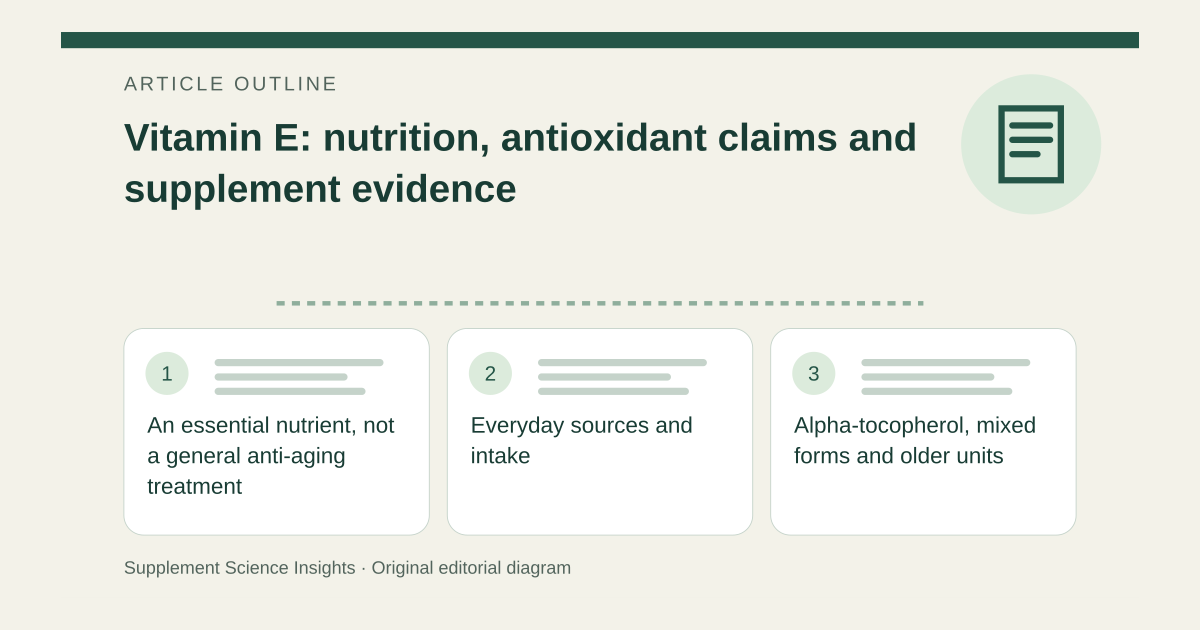
An essential nutrient, not a general anti-aging treatment
Vitamin E is a fat-soluble nutrient with antioxidant functions: it helps protect cells against oxidative damage. It also participates in immune function and cellular communication. Those biological roles are real, but they do not tell us whether taking extra vitamin E prevents a disease or improves how someone feels. [2]
The useful distinction is between maintaining adequate nutrition and using a supplement as a treatment. A claim about a normal function needs less evidence than a promise to prevent heart disease. The latter requires clinical outcomes in people, not simply evidence of antioxidant activity. [2]
Everyday sources and intake
Nuts, sunflower seeds and vegetable oils are useful dietary sources. Leafy vegetables and fortified foods can contribute too. The U.S. recommended dietary allowance for people aged 14 and older is 15 mg per day; during breastfeeding it is 19 mg. These are total daily intake values. [2][1]
Vitamin E deficiency is uncommon in otherwise healthy people. Disorders that interfere with fat absorption can change that picture and may require a clinician-selected preparation. A low estimate from a short food diary is not, by itself, a diagnosis of deficiency. [2][1]
Alpha-tocopherol, mixed forms and older units
Vitamin E includes several tocopherols and tocotrienols; alpha-tocopherol is the form used to meet human vitamin E requirements. Products may name natural-source d-alpha-tocopherol or synthetic dl-alpha-tocopherol. Their activity differs, and converting an older IU declaration to milligrams requires the correct form. [1]
Keep “mixed tocopherols” or “tocotrienols” separate from the declared vitamin E amount. The presence of a broader mixture is not evidence that the product delivers a better clinical outcome. A comparison should preserve the ingredient wording rather than replace it with a universal “more complete” ranking. [1]
What prevention claims can and cannot borrow
NCCIH’s evidence summary does not support routine vitamin E supplementation to prevent cardiovascular disease or cancer. Some trials have identified harm, including increased prostate-cancer risk in men given a particular high-dose preparation. That finding is about supplemental use in a studied setting, not an instruction to avoid vitamin E foods. [4][3]
There is a separate eye-care use: vitamin E is one ingredient in AREDS2 formulas for selected patients with age-related macular degeneration. The National Eye Institute’s guidance concerns the complete formula and disease stage. It cannot establish that vitamin E alone gives the same benefit. [4][3]
Bleeding risk belongs in the decision
High supplemental doses can increase bleeding risk. Anticoagulant or antiplatelet use makes the interaction especially relevant, so the exact product should be discussed with the treating clinician or pharmacist. A nutrient’s presence in food does not establish that a concentrated supplement is suitable with every medicine. [1]
Before a procedure or a medication review, include supplements in the list you bring. Record the form, serving amount and frequency instead of writing only “vitamins.” Follow the care team’s instructions rather than choosing a stopping interval from a generic online article. [1]
Compare servings without inventing equivalence
Consider two fictional labels that both declare vitamin E in milligrams. A lists 15 mg per two-softgel serving. B lists 15 mg per one-softgel serving. A supplies 7.5 mg per softgel according to its declaration; B supplies 15 mg. Equal amounts per serving do not mean equal amounts per capsule.
If a third label gives only IU and its form is unreadable, leave its milligram comparison unresolved. Do not guess the conversion from the brand, capsule color or a “natural” slogan. This exercise checks label arithmetic; it neither verifies the bottle’s contents nor recommends either serving.
| Label | Declared serving | Per softgel |
|---|---|---|
| A | 15 mg / 2 softgels | 7.5 mg |
| B | 15 mg / 1 softgel | 15 mg |
| C | IU only; form unreadable | Milligram comparison unresolved |
Choose the question before choosing the product
A useful assessment starts with one specific aim: filling a documented dietary gap, addressing a diagnosed absorption problem or following an eye-care plan. “Antioxidant support” alone leaves the outcome undefined and makes almost any product sound relevant.
For an advertised benefit, look for the studied preparation, participant group and outcome. For a nutrition question, look first at food intake and the declared amount. This article brings together authoritative summaries; it is not a trial-by-trial systematic review or a brand endorsement.
Sources for this article
- NIH Office of Dietary Supplements — Vitamin E: Health Professional Fact Sheet
Source consulted: 2026-09-17. This is a reference resource, not a claim that we conducted the studies or tested a product. - MedlinePlus Medical Encyclopedia — Vitamin E
Source consulted: 2026-09-17. This is a reference resource, not a claim that we conducted the studies or tested a product. - National Eye Institute — AREDS2 supplements for AMD
Source consulted: 2026-09-17. This is a reference resource, not a claim that we conducted the studies or tested a product. - NCCIH — Antioxidant Supplements: What You Need To Know
Source consulted: 2026-09-17. This is a reference resource, not a claim that we conducted the studies or tested a product.