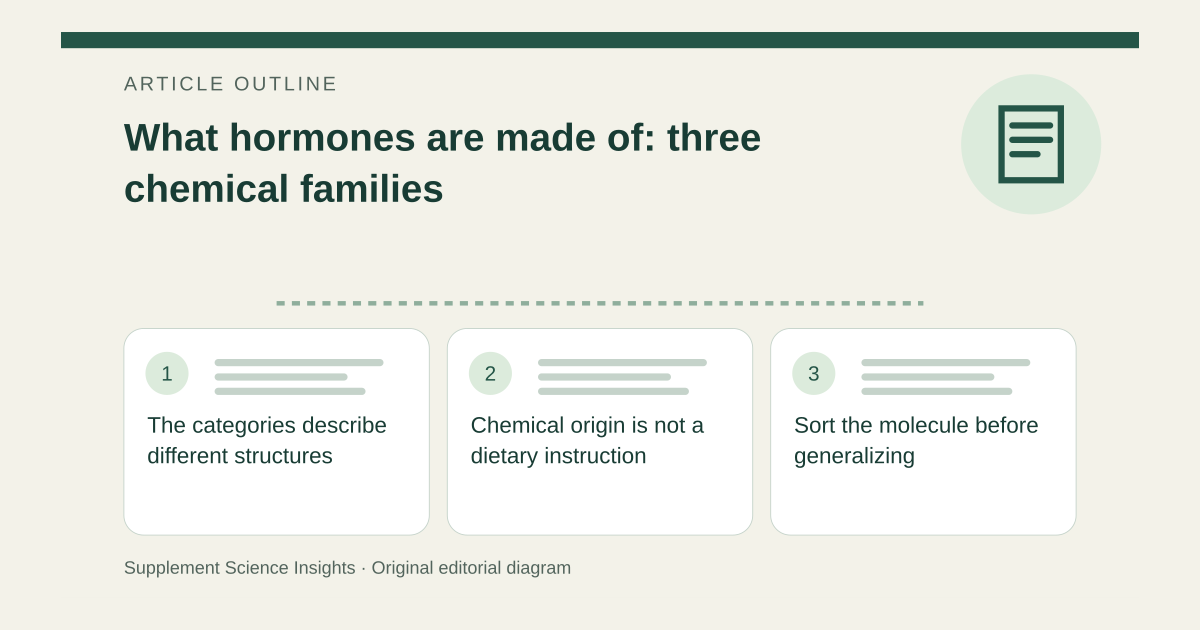
The categories describe different structures
Amine hormones are derived from individual amino acids; examples include tyrosine-derived catecholamines and thyroid hormones. Peptide and protein hormones instead contain chains of amino-acid residues. [1]
Steroid hormones have a different starting framework: cholesterol. Examples include cortisol, aldosterone, estrogen and testosterone. It would therefore be incorrect to say that every hormone is a protein or that every hormone is made from cholesterol. [1]
Chemical origin is not a dietary instruction
A precursor relationship does not establish that eating more of that precursor raises a hormone to a desirable level. A nutrient source, a biosynthetic pathway and a hormone treatment are separate questions. [1]
Likewise, grouping hormones by composition does not make the members of a group interchangeable. Their receptors, tissues and physiological effects matter when interpreting a claim about hormonal activity. [1]
Sort the molecule before generalizing
Imagine comparing insulin and cortisol. Insulin belongs to the peptide/protein group, while cortisol is a steroid. A statement about the chemical construction of one cannot automatically describe the other.
| Detail | Interpretation |
|---|---|
| Amine | Individual amino-acid derivative |
| Peptide/protein | Amino-acid chain |
| Steroid | Cholesterol-derived framework |
Sources for this article
- 17.2 Hormones - Anatomy and Physiology 2e | OpenStax
Source consulted: 2026-09-17. This is a reference resource, not a claim that we conducted the studies or tested a product.