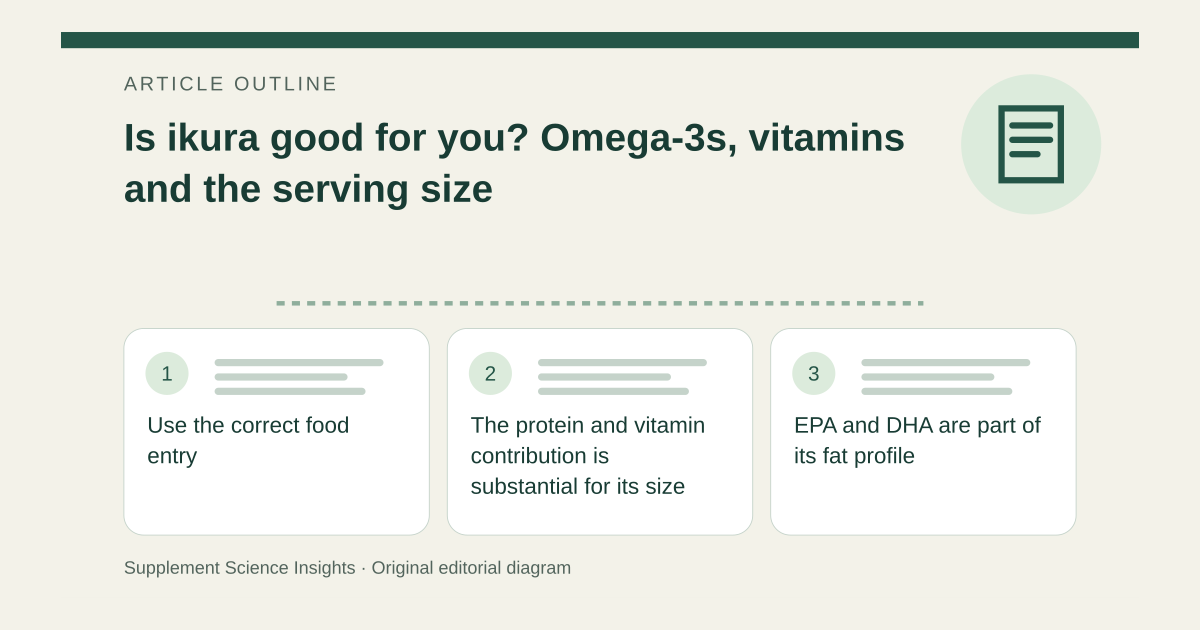
Use the correct food entry
Japan’s MEXT food table identifies item 10140 as salted chum salmon roe. Its standard values are per hundred grams of edible food. Salted roe, differently seasoned ikura and unsalted fish eggs need not have identical values, so the exact product label remains useful. [1]
The protein and vitamin contribution is substantial for its size
The table lists 32.6 g protein, 44 micrograms vitamin D and 47 micrograms B12 per hundred grams. A hypothetical twenty-gram portion therefore supplies about 6.5 g protein, 8.8 micrograms D and 9.4 micrograms B12. These are scaled composition estimates, not guarantees for every product. [1]
EPA and DHA are part of its fat profile
The corresponding MEXT fatty-acid table lists 1,600 mg EPA and 2,000 mg DHA per hundred grams. Scaling to twenty grams gives approximately 320 mg EPA and 400 mg DHA. Nutrient content does not by itself establish a clinical effect from eating a particular portion. [2]
Sodium rises with the portion too
MEXT lists 910 mg sodium per hundred grams, or about 182 mg in twenty grams. Larger portions and added soy-based seasonings can increase the meal’s sodium contribution. Evaluate ikura within the whole meal rather than focus only on the desirable vitamins and fats. [1]
A portion-based comparison
Imagine using twenty grams as a topping instead of eating the full hundred grams used by the database. Multiply the listed values by 0.2 for that estimate. The arithmetic changes the nutrient contribution but does not turn the selected portion into a prescribed daily target. [1][2]
| Nutrient | Approximate amount |
|---|---|
| Protein | 6.5 g |
| Vitamin D | 8.8 micrograms |
| Vitamin B12 | 9.4 micrograms |
| EPA plus DHA | 720 mg |
| Sodium | 182 mg |
Sources for this article
- 魚介類/<魚類>/(さけ・ます類)/しろさけ/イクラ - 01.一般成分表-無機質-ビタミン類
Source consulted: 2026-09-21. This is a reference resource, not a claim that we conducted the studies or tested a product. - 魚介類/<魚類>/(さけ・ます類)/しろさけ/イクラ - 06.脂肪酸-可食部100g
Source consulted: 2026-09-21. This is a reference resource, not a claim that we conducted the studies or tested a product.