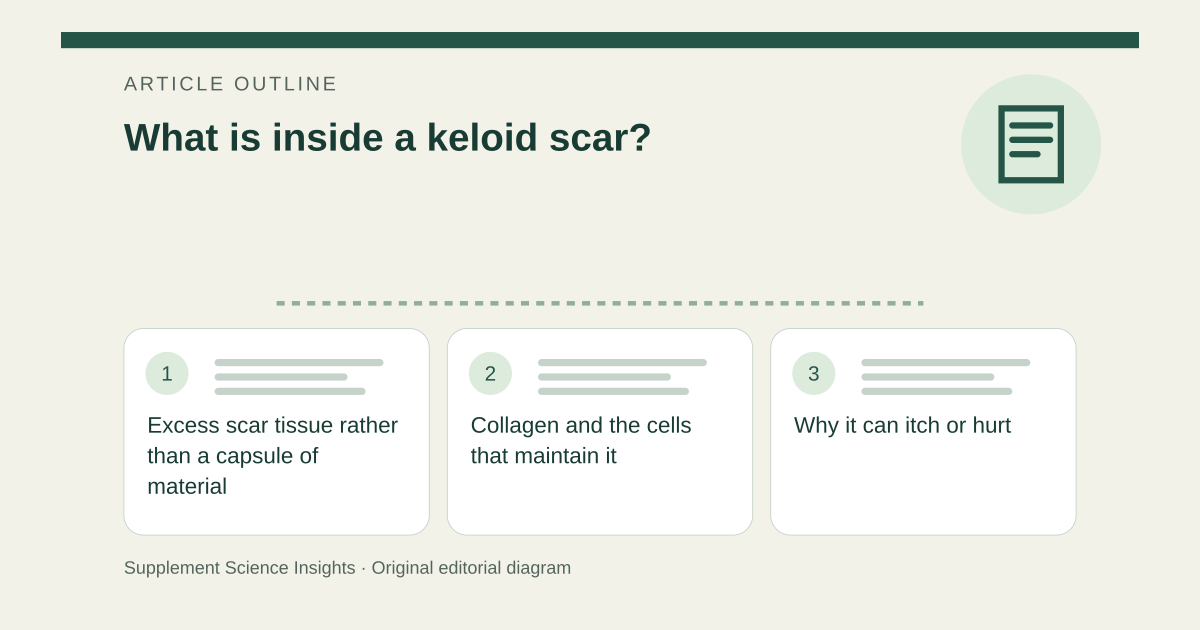
Excess scar tissue rather than a capsule of material
A keloid is an overgrown scar that extends beyond the original injury's boundaries. The American Academy of Dermatology explains that the body produces more collagen than needed during the healing process. The raised area is tissue, not an ordinary fluid-filled compartment. [1][2]
This distinction matters when people ask what is inside it. Its firmness comes from an altered extracellular matrix and cellular activity. Trying to drain or cut it is not a way to remove a simple stored substance and can create further injury. [1][2]
Collagen and the cells that maintain it
Histological descriptions identify abundant collagen arranged in irregular patterns or whorls. Fibroblasts participate in producing the matrix, and other cell populations and the overlying skin can also differ from ordinary scar tissue. Both type I and type III collagen are present; a keloid is not made from just one purified collagen type. [2][3]
The important feature is the organization and excessive accumulation of tissue. Saying that collagen is a normal structural protein does not mean that any amount or distribution of it is beneficial. [2][3]
Why it can itch or hurt
Skin is a living, innervated tissue, and keloids can be itchy or painful. Those symptoms do not show that the scar contains a foreign object or a collection of pus. The exact biology of keloid formation and symptoms is still being investigated. [2][1]
A changing lump should not be diagnosed from this description alone. Assessment can distinguish a scar from other skin problems and consider appropriate treatment. The anatomy of a keloid also does not establish that eating less collagen or taking a collagen supplement will resolve it. [2][1]
A hypothetical tissue explanation
Imagine a drawing of a raised scar as a bag filled with collagen liquid. A better model shows a thickened network of collagen with cells and surrounding skin structures. That model explains why a keloid is a tissue-growth problem rather than something that can simply be squeezed out. [2]
| Feature | Better explanation |
|---|---|
| Firm raised area | Excess and altered scar matrix |
| Collagen | Part of a living tissue, not a loose filling |
| Itch or pain | Symptoms that do not identify the contents by themselves |
Sources for this article
- American Academy of Dermatology — Keloid causes
Source consulted: 2026-09-20. This is a reference resource, not a claim that we conducted the studies or tested a product. - Hypertrophic Scarring Keloids - StatPearls - NCBI Bookshelf
Source consulted: 2026-09-20. This is a reference resource, not a claim that we conducted the studies or tested a product. - NIH Curriculum Supplement — Musculoskeletal and Skin Systems
Source consulted: 2026-09-20. This is a reference resource, not a claim that we conducted the studies or tested a product.