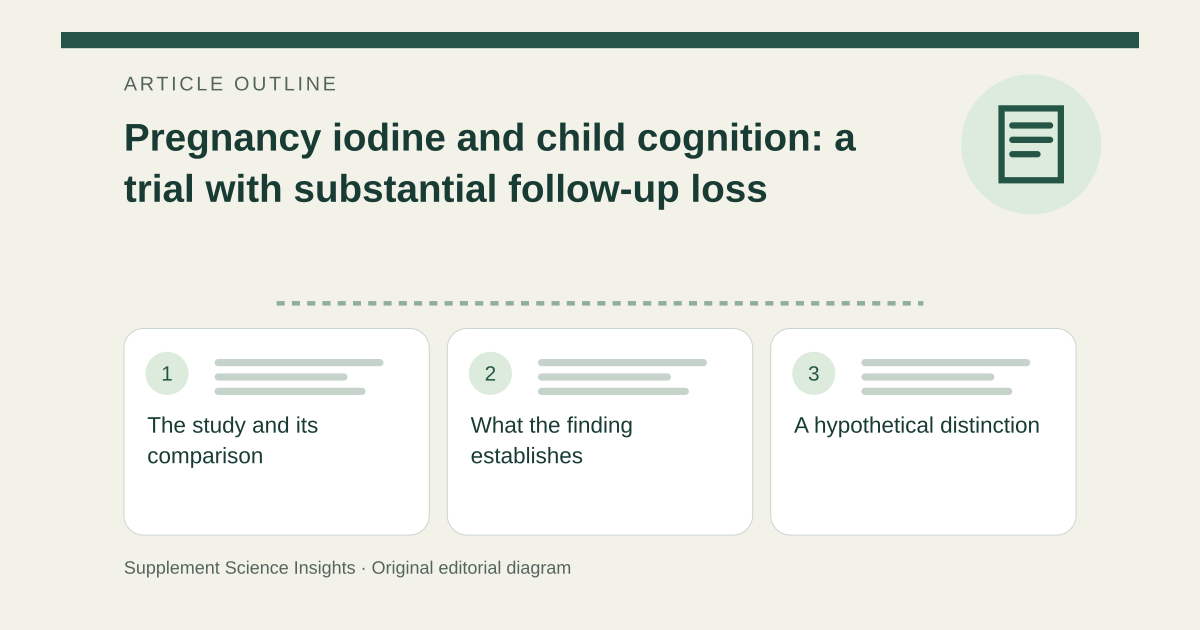
The study and its comparison
A trial in India and Thailand randomized 832 pregnant women to iodine 200 micrograms daily or placebo until delivery. Children were assessed at ages five to six years. [1]
Verbal and performance IQ analyses included 313 children; executive-function analysis included 315. None of these primary comparisons showed a significant benefit. [1]
What the finding establishes
The large reduction from maternal enrollment to child assessment limits interpretation. The study does not answer treatment of severe iodine deficiency or justify stopping prescribed prenatal care. Funding included Swiss National Science Foundation, Nestle Foundation and university support; full conflicts were not established from the record. [1]
A hypothetical distinction
Imagine many enrolled families do not contribute the final child test. The initial enrollment is not the outcome-analysis denominator.
| Detail | Interpretation |
|---|---|
| Measured outcome | Keep the endpoint specific |
| Study preparation | Not every retail product |
| Remaining uncertainty | Not resolved by a mechanism |
Sources for this article
- Effect of iodine supplementation in pregnant women on child neurodevelopment: a randomised, double-blind, placebo-controlled trial.
Source consulted: 2026-09-19. This is a reference resource, not a claim that we conducted the studies or tested a product.