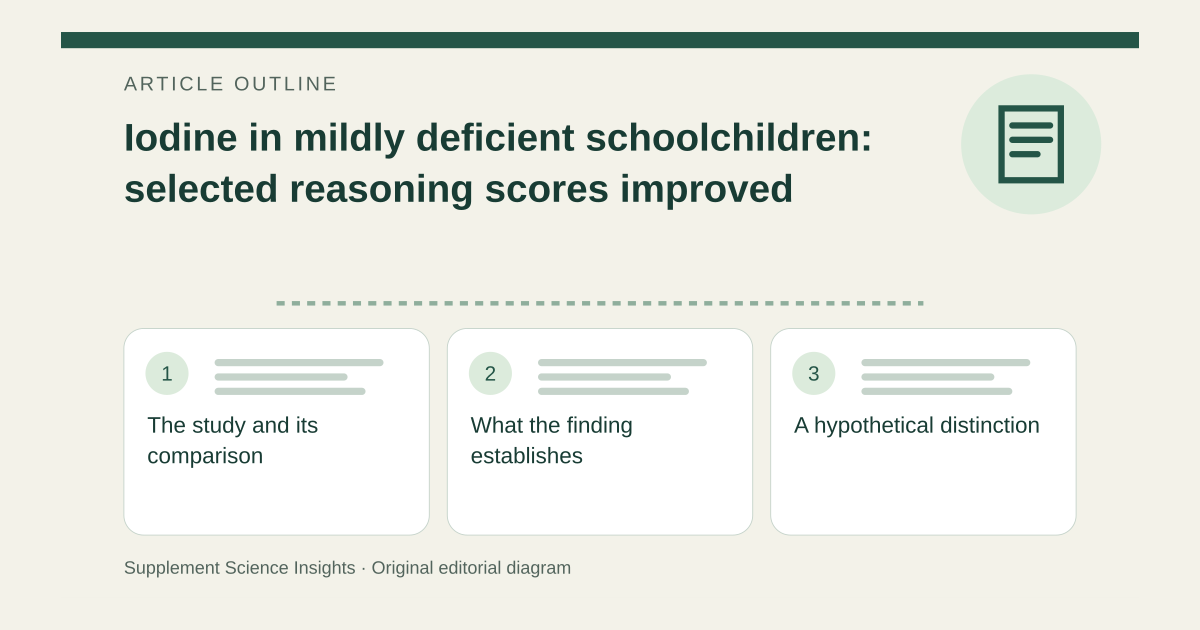
The study and its comparison
A New Zealand blinded trial randomized 184 children aged ten to thirteen to iodine or placebo for twenty-eight weeks. The children were mildly iodine deficient at baseline, and researchers administered four cognitive subtests. [1]
Supplementation improved iodine-status measures and two reasoning-related subtests. Letter-number sequencing and symbol search did not significantly improve. The combined cognitive score differed by about 0.19 standard deviations. [1]
What the finding establishes
The result does not establish benefits in iodine-sufficient children, adults or every cognitive domain. It also did not test iodine together with magnesium. Funding and conflicts were not established from the abstract. Correcting a measured population-level nutritional shortfall should not be generalized into a claim that more iodine makes everyone more intelligent. [1]
A hypothetical distinction
Imagine two of four tests improve in a deficient group. Report the unaffected tests and the baseline nutritional context.
| Detail | Interpretation |
|---|---|
| Measured outcome | Keep the endpoint specific |
| Study preparation | Not every retail product |
| Remaining uncertainty | Not resolved by a mechanism |
Sources for this article
- Iodine supplementation improves cognition in mildly iodine-deficient children.
Source consulted: 2026-09-19. This is a reference resource, not a claim that we conducted the studies or tested a product.