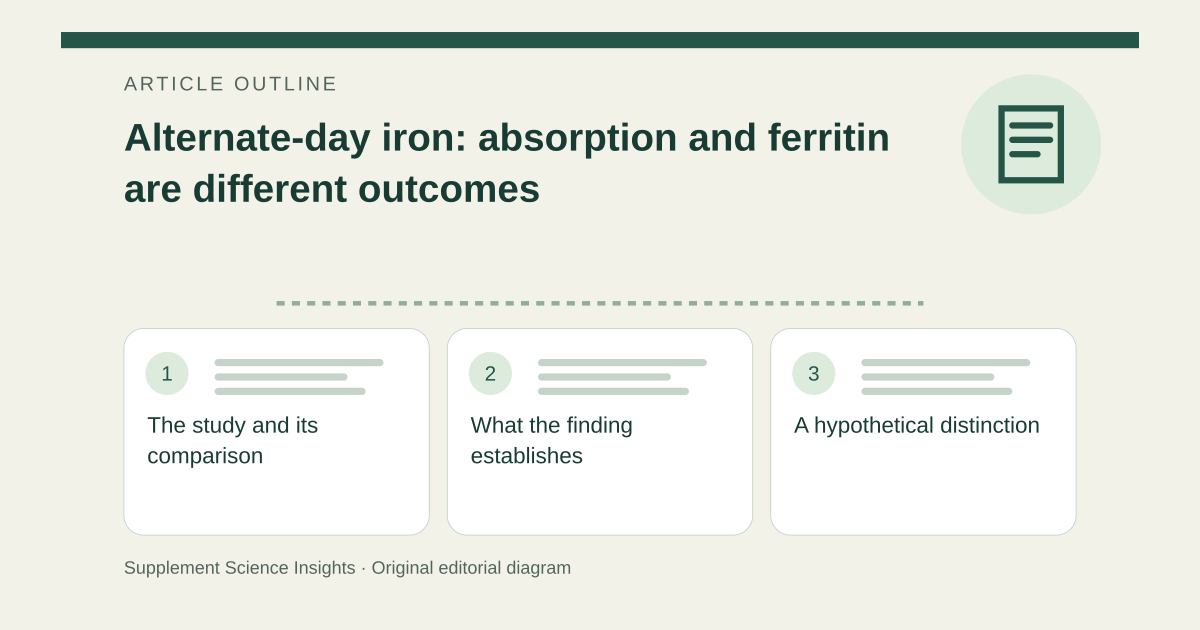
The study and its comparison
An open-label study in 40 iron-depleted women found greater fractional absorption with alternate-day dosing. A separate 20-woman experiment did not find better absorption from splitting the daily amount. [1][2]
A later masked trial randomized 150 women to 100 mg daily for 90 days followed by placebo, or iron and placebo on alternate days for 180 days. At equal cumulative iron doses, ferritin did not differ; gastrointestinal effects were less frequent with alternate-day use. [1][2]
What the finding establishes
Equal total dose comparisons occurred at different times. Six-month deficiency results also compare continued alternate-day iron with a group that had stopped iron. These Swiss-funded trials inform treatment discussions without prescribing a schedule for every cause of anemia. [1][2]
A hypothetical distinction
Imagine two regimens deliver the same total amount over different durations. Better absorption per dose does not guarantee faster recovery.
| Detail | Interpretation |
|---|---|
| Measured outcome | Keep the endpoint specific |
| Study preparation | Not every retail product |
| Remaining uncertainty | Not resolved by a mechanism |
Sources for this article
- Iron absorption from oral iron supplements given on consecutive versus alternate days and as single morning doses versus twice-daily split dosing in iron-depleted women: two open-label, randomised controlled trials.
Source consulted: 2026-09-19. This is a reference resource, not a claim that we conducted the studies or tested a product. - Alternate day versus consecutive day oral iron supplementation in iron-depleted women: a randomized double-blind placebo-controlled study.
Source consulted: 2026-09-19. This is a reference resource, not a claim that we conducted the studies or tested a product.