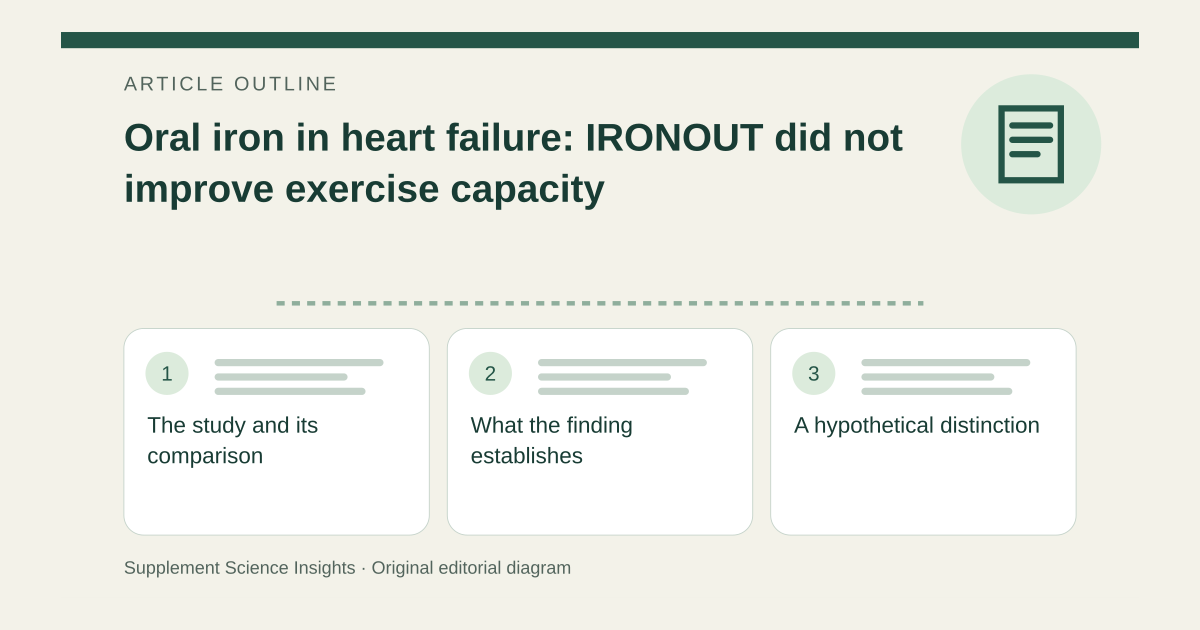
The study and its comparison
IRONOUT HF randomized 225 adults with reduced-ejection-fraction heart failure and defined iron deficiency to oral iron polysaccharide, 150 mg twice daily, or placebo. Two hundred three completed the study. [1]
The primary change in peak oxygen uptake did not differ significantly. Six-minute walking distance, NT-proBNP and heart-failure quality-of-life scores also did not improve relative to placebo. [1]
What the finding establishes
These results concern this oral preparation and duration, not all iron routes. They do not support promising better exercise tolerance from an over-the-counter iron product in this population. Full funding and conflict details were not established from the retrieved abstract. [1]
A hypothetical distinction
Imagine a nutrient deficit accompanies poor exercise tolerance. Correcting intake is a hypothesis, not proof of improved function.
| Detail | Interpretation |
|---|---|
| Measured outcome | Keep the endpoint specific |
| Study preparation | Not every retail product |
| Remaining uncertainty | Not resolved by a mechanism |
Sources for this article
- Effect of Oral Iron Repletion on Exercise Capacity in Patients With Heart Failure With Reduced Ejection Fraction and Iron Deficiency: The IRONOUT HF Randomized Clinical Trial.
Source consulted: 2026-09-19. This is a reference resource, not a claim that we conducted the studies or tested a product.