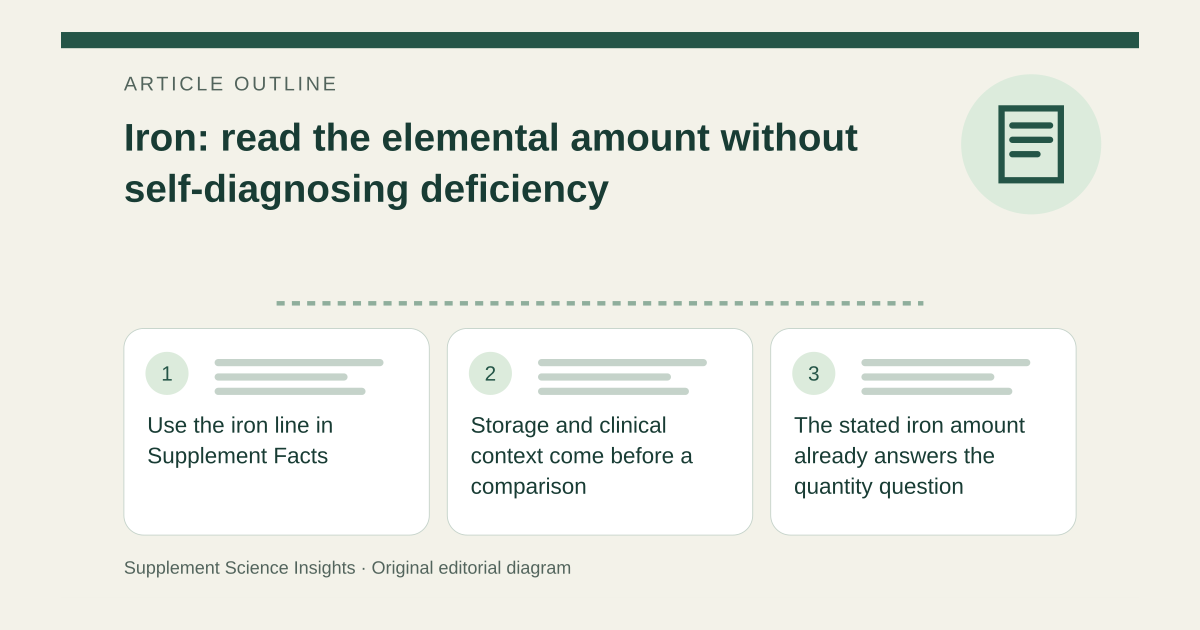
Use the iron line in Supplement Facts
Iron supplements contain different compounds, but the Supplement Facts iron amount describes elemental iron. NIH ODS notes that consumers do not need to calculate it from the compound’s weight. Record the declared amount and form together. [1]
The word “iron” on two packages does not establish identical serving sizes or directions. Locate the exact strength and format, and preserve a photograph of the full label. A front-panel claim alone may omit information needed for a fair comparison. [1]
Storage and clinical context come before a comparison
Iron overdose can be fatal, especially in children. Keep iron products secured out of children’s reach. If an overdose is suspected, seek immediate medical or poison-center assistance. Do not wait for the label worksheet to be completed. [1]
High supplemental intakes can cause nausea, constipation and other gastrointestinal effects. Iron overload disorders such as hereditary hemochromatosis require clinical guidance. These considerations make an unsupervised “more is better” approach inappropriate. [1]
The stated iron amount already answers the quantity question
Imagine a fictional label that declares 12 mg iron, as ferrous gluconate, per capsule. The recorded elemental amount is 12 mg. Do not multiply that declared amount by a compound percentage: that would apply a conversion to a number already expressed as iron.
Two capsules would account for 24 mg by arithmetic, but this is not an instruction to take two. The example demonstrates a common recording error. It supplies no treatment dose, intake target or reason for selecting this particular form.
| Field | Interpretation |
|---|---|
| Iron: 12 mg per capsule | Declared elemental amount |
| As ferrous gluconate | Named form; do not reconvert the 12 mg |
| Two capsules: 24 mg by arithmetic | Illustration only, not a direction to take two |
| Treatment dose | Not supplied by this example |
A symptom or a single number is not a treatment plan
ODS describes iron-status assessment using blood measurements and clinical context. Ferritin can be affected by inflammation. A label cannot diagnose iron deficiency or determine why a test result is abnormal. [1]
Bring existing results, symptoms, medicines and the proposed product to a clinician. Ask what finding is being treated, how the cause will be assessed and how response will be followed. This page deliberately supplies no ferritin target or dosing schedule. [1]
Ask about the exact medicine and preparation
Iron can interfere with levothyroxine and levodopa. Acid-suppressing medicines can also affect iron absorption. Ask a pharmacist to review the actual products and schedule instead of applying a timing rule copied from a different medicine. [1]
If a preparation is difficult to tolerate, document the exact product and the problem for that discussion. Do not infer that a marketing phrase guarantees freedom from side effects or that changing the form alone resolves the underlying clinical issue. [1]
Separate an accurate record from a recommendation
A useful final note for the example is: “The label declares 12 mg elemental iron per capsule; personal need and use remain unresolved.” That statement is more precise than ranking bottles by the largest number on the front.
No retail batch, treatment outcome or comparative tolerability claim is verified here. The government synthesis supplies background; independent appraisal of a particular intervention and final editorial review remain separate tasks.
Sources for this article
- NIH ODS — Iron: Health Professional Fact Sheet
Source consulted: 2026-09-17. This is a reference resource, not a claim that we conducted the studies or tested a product.