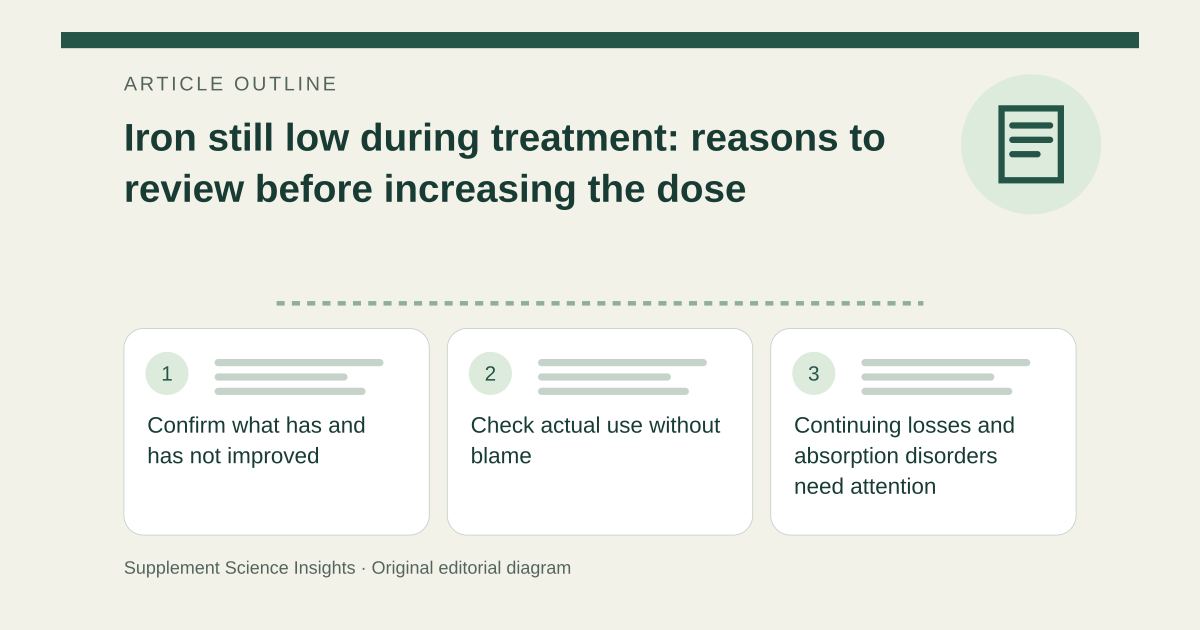
Confirm what has and has not improved
The phrase “iron is still low” can refer to hemoglobin, ferritin or another measurement. These describe different parts of the picture and may change at different rates. Start with the exact test, units, dates and the treatment goal. [1]
ODS notes that inflammation affects ferritin and that several markers may be needed to understand iron status. An isolated number is not enough to conclude that all oral iron has failed or that a stronger product is required. [1]
Check actual use without blame
Constipation, nausea, difficult schedules and interaction instructions can make a regimen hard to follow. A record of doses actually taken is more useful than repeating the prescription directions. MedlinePlus advises discussing formulation changes when adverse effects interfere. [2]
Food, calcium, antacids and certain medicines can affect absorption or scheduling. Review the exact combination with the pharmacist. Correcting a practical barrier may be more useful than increasing a dose that is already poorly tolerated. [2]
Continuing losses and absorption disorders need attention
Heavy menstrual or gastrointestinal bleeding can keep removing iron during replacement. Gastrointestinal disease or surgery can also affect absorption, and ODS notes that proton pump inhibitors may contribute to a suboptimal response in people already iron deficient. [1][3]
Another cause of anemia may also require consideration. A low hemoglobin is not synonymous with iron deficiency, and treatment should be reassessed when the response does not fit the presumed diagnosis. [1][3]
A stalled result can have a practical explanation
Imagine someone is prescribed daily iron but manages only occasional doses because of nausea, while heavy bleeding continues. The stalled result does not isolate a product failure. Both insufficient tolerated treatment and ongoing losses are relevant to the next clinical decision.
| Record | Why it matters |
|---|---|
| Exact repeat test | Clarifies what remains abnormal |
| Actual doses and adverse effects | Shows whether treatment was feasible |
| Continuing bleeding or digestive disease | May require treatment beyond changing a product |
Reassessment is preferable to unmonitored escalation
Contact the treating team if the expected response is not occurring or symptoms worsen. More iron can increase gastrointestinal harm and will not by itself resolve every cause of anemia or blood loss. Do not switch to another route or combine multiple iron products without a plan. [2][1][3]
This page provides a structured review of possible explanations, not a diagnosis of why an individual result remains abnormal. [2][1][3]
Sources for this article
- NIH ODS — Iron: Health Professional Fact Sheet
Source consulted: 2026-09-17. This is a reference resource, not a claim that we conducted the studies or tested a product. - MedlinePlus — Taking iron supplements
Source consulted: 2026-09-17. This is a reference resource, not a claim that we conducted the studies or tested a product. - NHS — Iron deficiency anaemia
Source consulted: 2026-09-17. This is a reference resource, not a claim that we conducted the studies or tested a product.