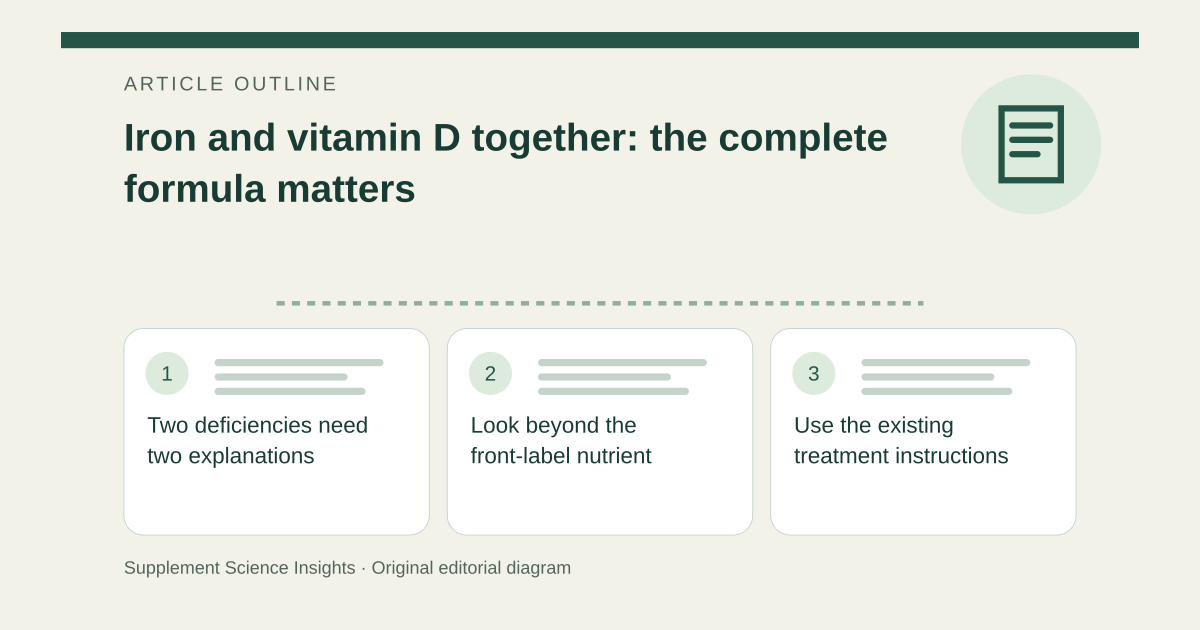
Two deficiencies need two explanations
Iron supports hemoglobin and other functions, while vitamin D supports calcium absorption and bone health. Having a reason to supplement one does not establish a reason to take the other. Prescribed treatment should reflect the actual deficiency, medical history and monitoring plan rather than a generic pairing recommendation. [1][2]
Look beyond the front-label nutrient
A product sold for vitamin D may also contain calcium. Calcium can reduce iron absorption, and ODS notes that taking individual calcium and iron supplements at different times is often suggested. This does not mean vitamin D itself is calcium or that every vitamin D product creates the same timing issue. Ask the pharmacist to review the exact preparation. [1][3]
Use the existing treatment instructions
Imagine iron has been prescribed and a person adds a calcium-plus-D tablet. Show both labels to the pharmacist to establish a schedule that fits treatment and tolerability. Do not change the iron amount to compensate for a guessed absorption loss or assume more vitamin D improves iron response. [1][2][3]
| Situation | Interpretation |
|---|---|
| Vitamin D only | Not the same formula as calcium plus D |
| Iron prescription | Keep the treatment purpose and schedule clear |
| Additional calcium | Review timing with the pharmacist |
Sources for this article
- Iron - Health Professional Fact Sheet
Source consulted: 2026-09-20. This is a reference resource, not a claim that we conducted the studies or tested a product. - Vitamin D - Health Professional Fact Sheet
Source consulted: 2026-09-20. This is a reference resource, not a claim that we conducted the studies or tested a product. - Calcium - Health Professional Fact Sheet
Source consulted: 2026-09-20. This is a reference resource, not a claim that we conducted the studies or tested a product.