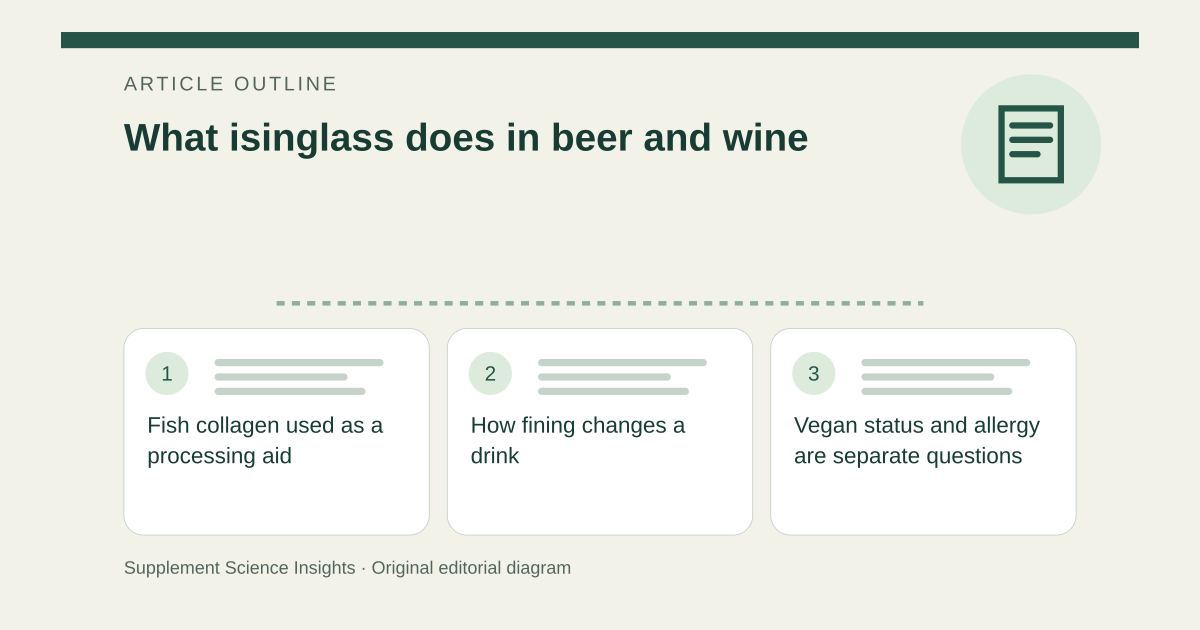
Fish collagen used as a processing aid
Isinglass is a preparation of collagen obtained from fish swim bladders. The food-science assessment describes drying and processing the starting material into forms suited to beverage production. It is therefore animal-derived even when used in a drink made mainly from grains or grapes. [1][2]
Its purpose is clarification, also called fining. A fining agent interacts with material in the beverage so that the resulting complexes can separate. This is a processing function, not a claim that the drink provides a useful collagen supplement. [1][2]
How fining changes a drink
The Australian Wine Research Institute describes isinglass as useful for clarifying white wine, with different effects on phenolic compounds and astringency from other fining agents. After treatment, settling and separation remove material from the wine. The appropriate process depends on the beverage and the desired result. [2]
Using a processing aid does not mean all of it remains in the final bottle, but removal is also not something a consumer can quantify from the ingredient name alone. Process details and testing matter when residual material is the question. [2]
Vegan status and allergy are separate questions
For a vegan purchasing decision, the use of a fish-derived processing aid can matter even when it is subsequently removed. Ask the producer whether animal-derived fining agents are used rather than inferring the answer from a beverage's plant ingredients or clarity. [1][2]
Allergy is a different issue involving the relevant proteins and exposure. The FSANZ assessment discusses residual fish proteins and manufacturing controls; it should not be converted into a universal guarantee for every beverage or every person with fish allergy. Product-specific information and clinical advice are more useful than assuming that clear appearance means no relevant residue. [1][2]
A hypothetical clarification record
Suppose a winery records an isinglass fining step followed by filtration. That record establishes that a fish-derived aid was used. It does not establish a collagen dose in the bottled wine, and it does not by itself quantify any residual fish protein. Those are separate measurements. [2][1]
| Record | What it answers |
|---|---|
| Isinglass used | A fish-derived fining aid entered the process |
| Filtration completed | A separation step occurred |
| Residual-protein test | Evidence about the measured final residue |
Sources for this article
- FSANZ A490: Isinglass assessment (2008)
Source consulted: 2026-09-20. This is a reference resource, not a claim that we conducted the studies or tested a product. - Fining Agents - The Australian Wine Research Institute
Source consulted: 2026-09-20. This is a reference resource, not a claim that we conducted the studies or tested a product.