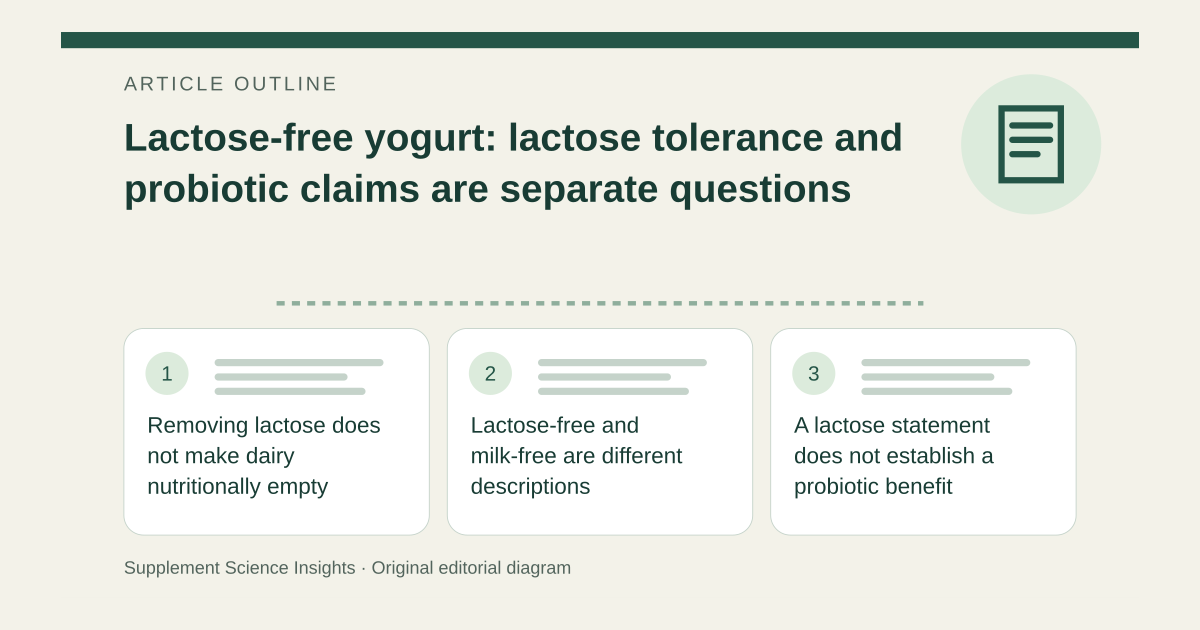
Removing lactose does not make dairy nutritionally empty
NIDDK describes lactose-free and lactose-reduced milk products as useful options for people managing lactose intolerance. Yogurt is also often better tolerated than some other milk products, although individual tolerance varies. [1][2][3]
Compare the actual product’s protein, calcium and any vitamin D fortification rather than assuming every yogurt is identical. Added ingredients and serving size can also differ. Lactose-free describes one feature, not the entire nutritional profile. [1][2][3]
Lactose-free and milk-free are different descriptions
Lactose is a sugar; milk allergy is an immune response to milk components. A lactose-free dairy yogurt is therefore not automatically appropriate for someone with milk allergy. Keep the condition being managed attached to the choice. [1][2][3]
A nondairy alternative is another category again. Its nutrient content should be checked directly rather than assumed equivalent because it is sold beside yogurt. [1][2][3]
A lactose statement does not establish a probiotic benefit
The words lactose-free do not name a live microbial strain, its amount or a demonstrated health outcome. A claim that a product treats a digestive condition needs evidence about the relevant preparation and condition, separate from whether it contains lactose. [1][2][3]
This article does not rank brands or infer probiotic efficacy from a label category. For lactose intolerance, the practical questions are exposure, tolerance and maintaining nutritional adequacy. [1][2][3]
Two descriptions can be true without proving a third
Imagine a product is lactose-free and supplies calcium. Those facts can inform a food choice, but neither establishes that it reduces symptoms of a particular bowel disorder. That outcome would require separate evidence.
| Information | Interpretation |
|---|---|
| Lactose-free | Describes lactose exposure |
| Nutrient panel | Describes nutritional contribution |
| Probiotic benefit | Requires separate evidence |
Sources for this article
- NIDDK: Eating, Diet, and Nutrition for Lactose Intolerance
Source consulted: 2026-09-17. This is a reference resource, not a claim that we conducted the studies or tested a product. - NIDDK: Definition and Facts for Lactose Intolerance
Source consulted: 2026-09-17. This is a reference resource, not a claim that we conducted the studies or tested a product. - NIH ODS: Dietary Supplements — What You Need to Know
Source consulted: 2026-09-17. This is a reference resource, not a claim that we conducted the studies or tested a product.