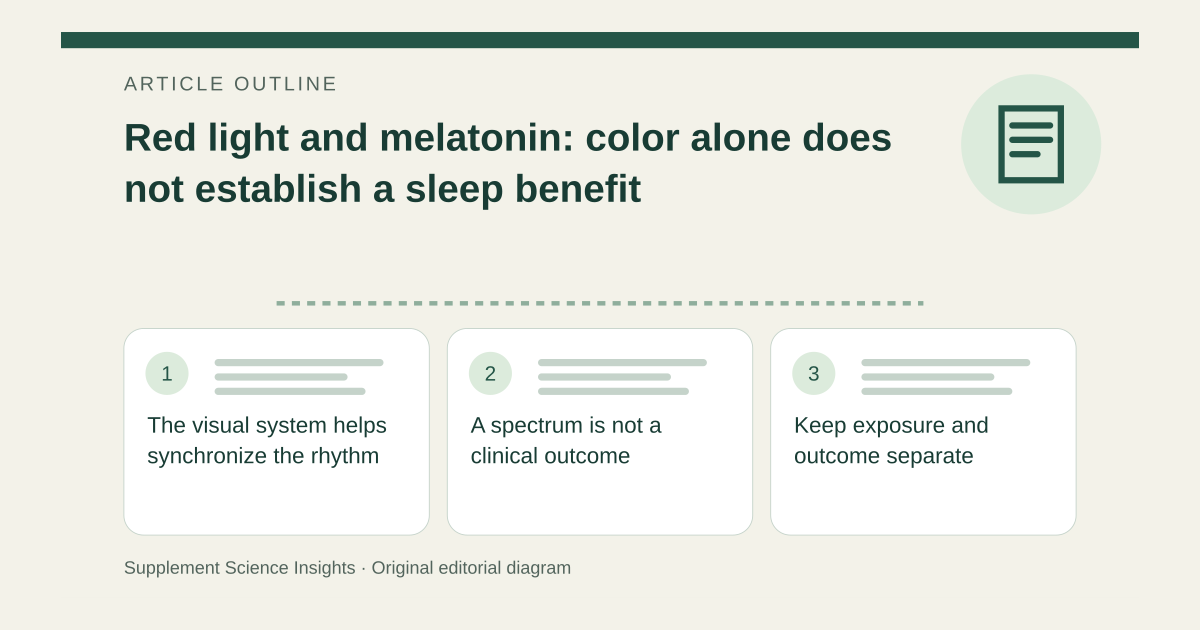
The visual system helps synchronize the rhythm
Endotext describes retinal input to the brain’s circadian system and the ability of light to suppress or shift melatonin secretion. It discusses sensitivity to shorter-wavelength light and the influence of exposure conditions. [1]
This physiology does not establish that every red-looking lamp raises melatonin. Reduced suppression under particular conditions is also different from actively increasing secretion above its natural pattern. [1]
A spectrum is not a clinical outcome
A product’s name or visible color does not fully specify its emitted spectrum or the exposure reaching the eyes. Even a defined exposure needs evidence for the outcome being advertised. [1]
Do not infer improved sleep quality from a wavelength claim alone. The source is a physiological reference, not a clinical test of a particular consumer device. [1]
Keep exposure and outcome separate
Imagine two lights both look red but differ in brightness and use time. The shared color description does not establish identical effects on a person’s rhythm.
| Detail | Interpretation |
|---|---|
| Color label | Incomplete exposure description |
| Intensity and timing | Affect response |
| Sleep benefit | Needs outcome evidence |
Sources for this article
- Physiology of the Pineal Gland and Melatonin - Endotext - NCBI Bookshelf
Source consulted: 2026-09-18. This is a reference resource, not a claim that we conducted the studies or tested a product.