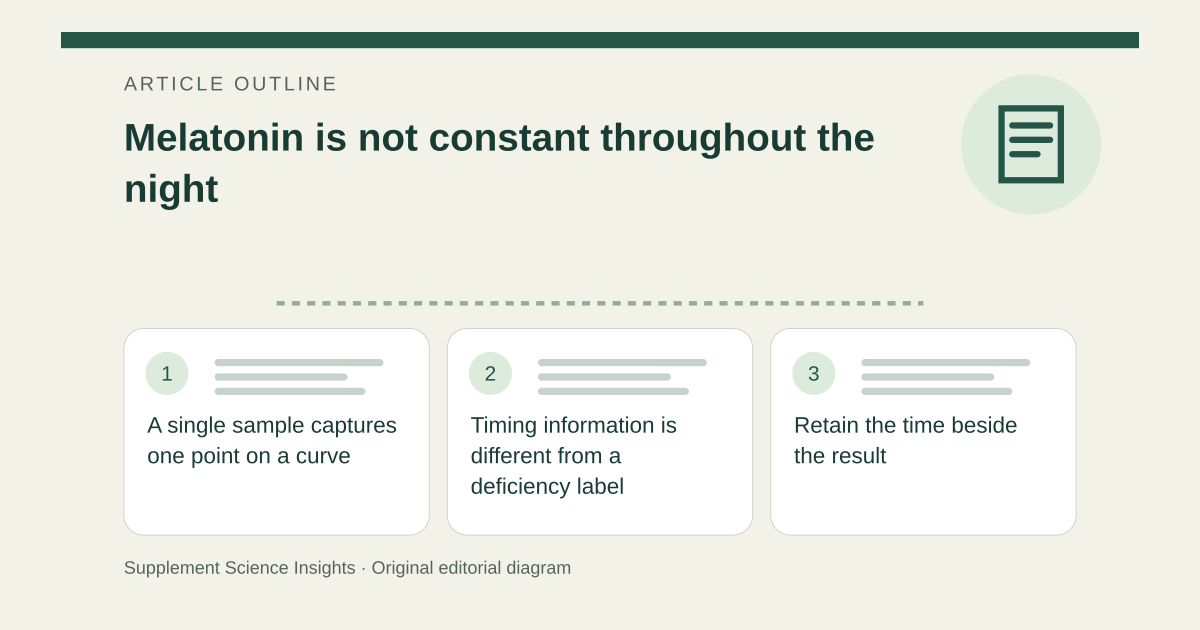
A single sample captures one point on a curve
Endotext describes a night-time rise and peak with lower levels outside that period. It also notes substantial differences in rhythm amplitude among people. [1]
A sample taken early in the evening cannot simply be compared with one collected near a later peak as if clock time were irrelevant. The sampling conditions belong with the number. [1]
Timing information is different from a deficiency label
Clinicians or researchers may study the phase of secretion rather than just asking whether a concentration is high or low. Light exposure and the collection protocol can influence interpretation. [1]
One low value, without its timing and context, does not establish a universal need for supplementation. An appropriate test interpretation must match the question being investigated. [1]
Retain the time beside the result
Imagine two results come from the same person at different overnight times. A difference can reflect the normal profile rather than a sudden change in overall production.
| Detail | Interpretation |
|---|---|
| Concentration | One time point |
| Phase | Timing of the rhythm |
| Amplitude | Size of the rhythm |
Sources for this article
- Physiology of the Pineal Gland and Melatonin - Endotext - NCBI Bookshelf
Source consulted: 2026-09-18. This is a reference resource, not a claim that we conducted the studies or tested a product.