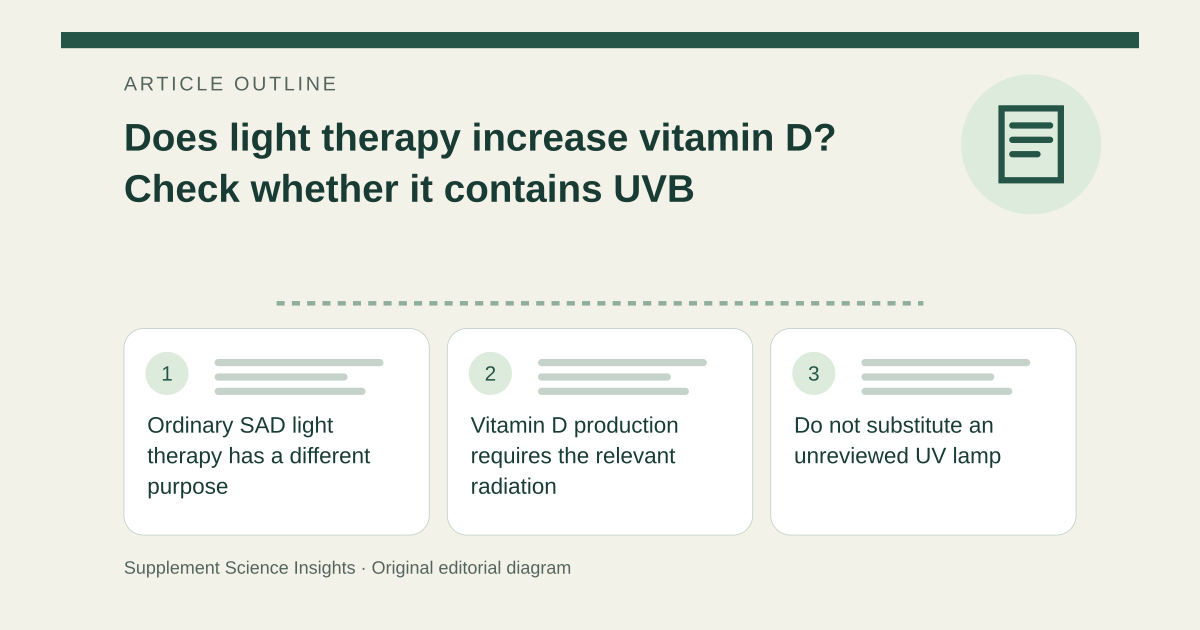
Ordinary SAD light therapy has a different purpose
NIMH describes bright-light therapy for winter-pattern seasonal affective disorder as exposure to a very bright box with potentially damaging UV filtered out. It is intended to address the seasonal mood condition, not to serve as a vitamin D replacement device. [1]
Vitamin D production requires the relevant radiation
NIH explains that UVB reaching skin initiates vitamin D synthesis. Brightness measured in lux does not tell you that a lamp supplies an appropriate UVB exposure. A bright visible lamp can therefore have a mood-treatment role without correcting a low vitamin D level. [2][1]
Do not substitute an unreviewed UV lamp
Ultraviolet exposure carries skin and eye risks. Do not turn to tanning equipment or an unidentified lamp as an improvised deficiency treatment. Vitamin D intake and supplementation can be managed separately using an appropriate clinical plan. [2]
Light therapy also needs individual suitability
NIMH notes that certain eye conditions and medicines that increase light sensitivity require medical supervision or alternative treatment. It also describes mixed results for vitamin D as a SAD treatment. One approach does not automatically replace the other. [1]
Check what outcome is being monitored
Imagine mood improves with a UV-filtered lamp. That improvement does not prove vitamin D increased. If deficiency is a separate concern, assess it on its own rather than using the lamp’s brightness or the person’s mood as a nutrient test. [1][2]
| Goal | Relevant question |
|---|---|
| Treat winter-pattern SAD | Is the reviewed light treatment suitable? |
| Correct low vitamin D | What nutrient plan is appropriate? |
| Read lamp brightness | Lux does not establish UVB output |
| Protect skin and eyes | Avoid improvised UV exposure |
Sources for this article
- Seasonal Affective Disorder - National Institute of Mental Health (NIMH)
Source consulted: 2026-09-21. This is a reference resource, not a claim that we conducted the studies or tested a product. - Vitamin D - Health Professional Fact Sheet
Source consulted: 2026-09-21. This is a reference resource, not a claim that we conducted the studies or tested a product.