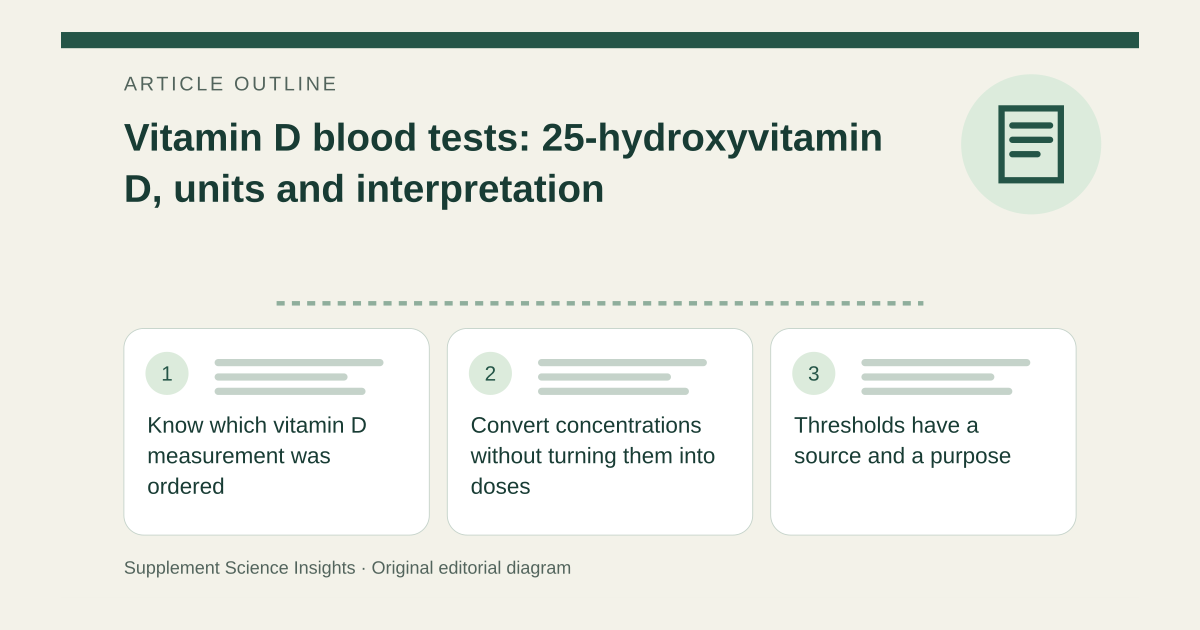
Know which vitamin D measurement was ordered
The main blood marker used to assess vitamin D status is 25-hydroxyvitamin D, often written 25(OH)D. It reflects vitamin D obtained through skin production, food and supplements. The active hormone, 1,25-dihydroxyvitamin D, is a different test and is generally not a good routine indicator of nutritional vitamin D status. [1]
The active form is tightly regulated and has a shorter circulating half-life. Its result should not be substituted for a 25(OH)D result simply because the name sounds more biologically important. [1]
Convert concentrations without turning them into doses
Laboratories commonly report 25(OH)D in ng/mL or nmol/L. One ng/mL equals 2.5 nmol/L. Those concentration units are different from the micrograms or IU used to describe an oral supplement. [1]
A concentration can be converted between its own units, but no simple unit conversion changes a blood result into the right daily dose. Baseline status, intake history, duration and health context affect the response. [1]
Thresholds have a source and a purpose
ODS reports the U.S. Food and Nutrition Board view that 20 ng/mL or more is sufficient for most people and that deficiency risk increases below 12 ng/mL. These are population-oriented reference interpretations, not evidence that everyone benefits from pursuing the highest result. [1][2]
Laboratory assay differences can also affect reported values. The Endocrine Society’s 2024 prevention guideline does not identify one blood threshold that produces outcome-specific benefit in healthy adults and suggests against routine screening in that population. Testing for an established clinical indication is a separate situation. [1][2]
Recognize two reports of the same concentration
A hypothetical result of 20 ng/mL is equivalent to 50 nmol/L: 20 multiplied by 2.5 equals 50. It is not a rise from 20 to 50 if the two reports use different units. Keep the test name, units, laboratory and date visible when comparing results.
| Observation | Meaning |
|---|---|
| 20 ng/mL × 2.5 | 50 nmol/L |
| 50 nmol/L ÷ 2.5 | 20 ng/mL |
| An oral amount in IU | Cannot be obtained by that blood-unit conversion |
Ask what decision the test is meant to inform
A clinician may use testing when a condition or treatment requires it, but an online symptom list does not establish that everyone should be screened. Likewise, a result above a chosen internet target is not automatically a better result; excessive vitamin D intake can cause harm. [1][2]
Bring all supplement amounts and prescribed regimens to the review. This article explains measurement and guideline scope without diagnosing a particular result or recommending a testing interval. [1][2]
Sources for this article
- NIH ODS — Vitamin D: Health Professional Fact Sheet
Source consulted: 2026-09-17. This is a reference resource, not a claim that we conducted the studies or tested a product. - Endocrine Society — Vitamin D for the Prevention of Disease
Source consulted: 2026-09-17. This is a reference resource, not a claim that we conducted the studies or tested a product.