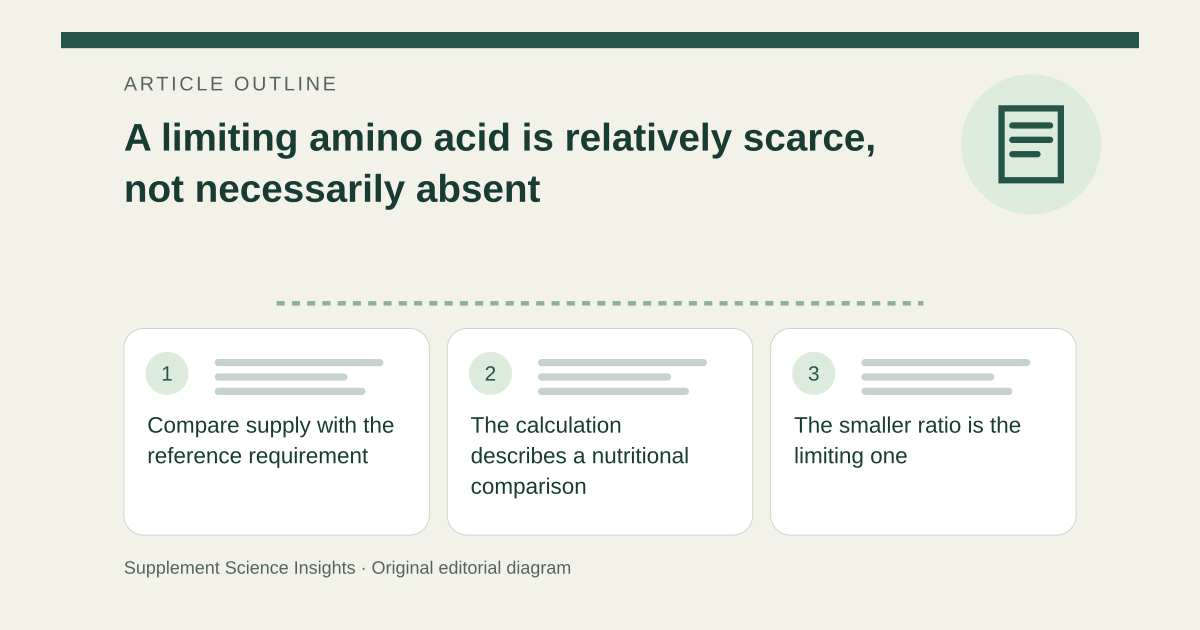
Compare supply with the reference requirement
FAO’s protein-quality framework compares an amino acid supplied by a protein with the amount in a reference pattern. The lowest relative ratio identifies the first-limiting amino acid. [1]
Two amino acids can have different absolute amounts yet a different ordering after comparison with their respective requirements. The denominator is therefore essential to the interpretation. [1]
The calculation describes a nutritional comparison
Finding a limiting amino acid does not by itself diagnose a person’s deficiency. Actual intake, the other foods consumed and the relevant nutritional requirements still matter. [1]
It is also different from saying a food contains no amount of that amino acid. A useful explanation reports the relative shortage and the reference used instead of dividing foods into nutritionally perfect and worthless categories. [1]
The smaller ratio is the limiting one
Imagine two indispensable amino acids have supply-to-reference ratios of 0.8 and 1.1. The first is more limiting, even if its absolute amount in milligrams is larger. This example illustrates ratios, not a measured score for any food.
| Detail | Interpretation |
|---|---|
| Absolute amount | Needs a reference for interpretation |
| Lowest relative ratio | Identifies the limiting amino acid |
| Individual deficiency | Not diagnosed by this ratio alone |
Sources for this article
- Dietary protein quality evaluation in human nutrition
Source consulted: 2026-09-17. This is a reference resource, not a claim that we conducted the studies or tested a product.