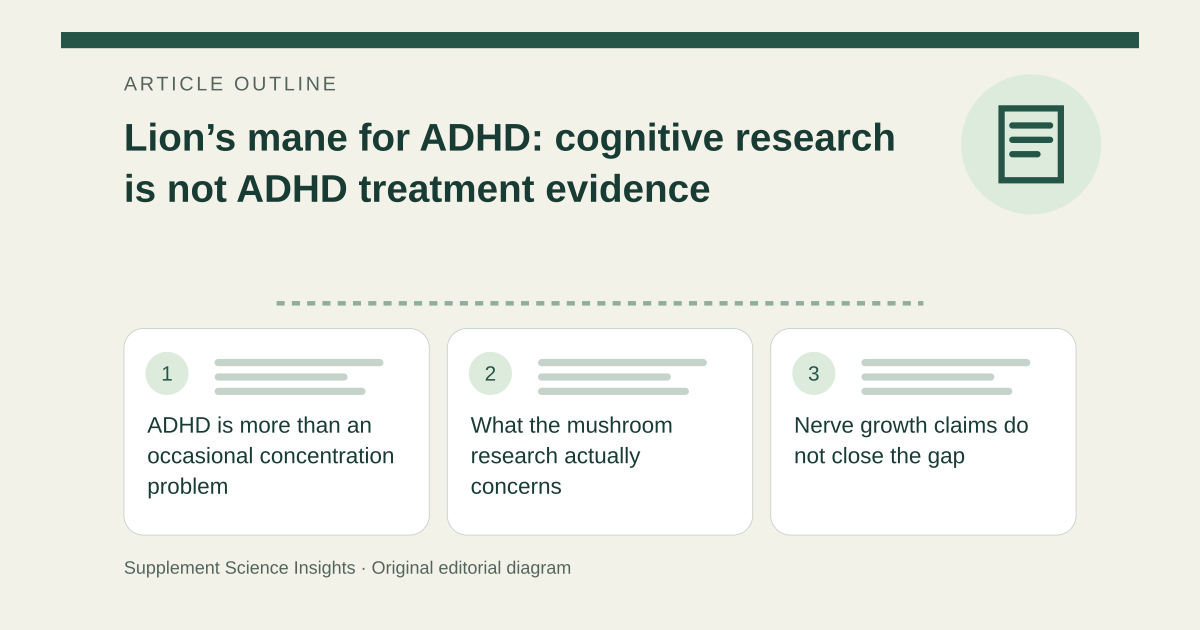
ADHD is more than an occasional concentration problem
NIMH describes persistent inattention, hyperactivity and/or impulsivity that interferes with daily life across situations. Improving a laboratory task or feeling temporarily more focused is not the same as treating this pattern. Assessment also considers co-occurring conditions such as sleep problems, anxiety and learning difficulties. [1]
What the mushroom research actually concerns
MSK summarizes limited lion’s mane studies of memory, cognitive impairment, mood and stress, including inconsistent findings in younger adults. Those populations and outcomes do not establish efficacy for diagnosed ADHD. The inspected clinical summary provides no validated ADHD dose or evidence that it can replace ADHD medication. [2]
Nerve growth claims do not close the gap
Preclinical work on nerve growth factors and neuroprotective activity offers research hypotheses. It does not demonstrate that a capsule corrects ADHD brain function or improves school, work and relationship outcomes. Those claims require suitable human ADHD trials. [2][1]
Keep established care in view
NIMH identifies medication and psychosocial interventions, including behavioral approaches and school support, as standard ADHD treatments. Discuss continuing symptoms with the treating clinician. A supplement should not be used to change prescribed doses or delay a proper evaluation. [1]
A child’s supplement decision needs its own review
Imagine a parent considering lion’s mane because an adult advert describes better memory. That advert does not provide pediatric ADHD efficacy or safety. Bring the label to the child’s clinician, and track actual school and home difficulties within the existing treatment plan. [3][1][2]
| Claim | Missing evidence |
|---|---|
| Supports nerve growth | Human ADHD outcomes |
| Improves an adult memory score | Childhood ADHD benefit |
| Replaces medication | Comparative treatment evidence |
Sources for this article
- Attention-Deficit/Hyperactivity Disorder (ADHD) - National Institute of Mental Health (NIMH)
Source consulted: 2026-09-21. This is a reference resource, not a claim that we conducted the studies or tested a product. - Lion's Mane Mushroom | Memorial Sloan Kettering Cancer Center
Source consulted: 2026-09-21. This is a reference resource, not a claim that we conducted the studies or tested a product. - Dietary Supplements: What You Need to Know
Source consulted: 2026-09-21. This is a reference resource, not a claim that we conducted the studies or tested a product.