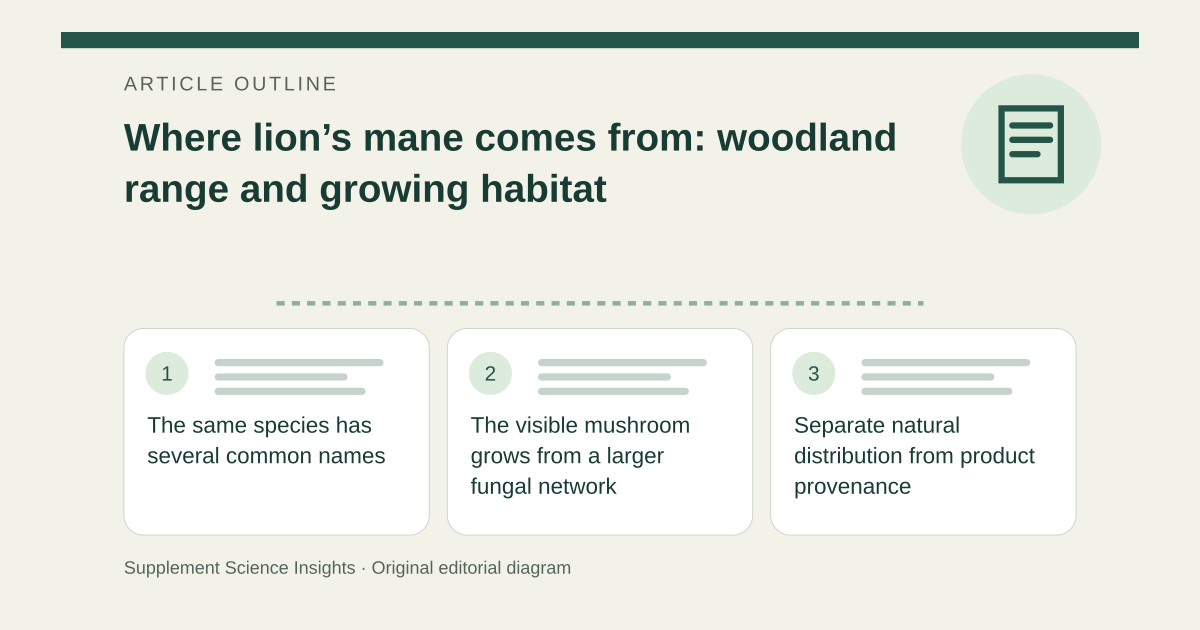
The same species has several common names
Hericium erinaceus is known as lion’s mane or bearded tooth. Woodland Trust describes its native range across Europe, Asia and North America. In Britain it is particularly associated with southern English beech woods; Missouri’s conservation guide also records it in that state. It is not a species originating exclusively in one country. [1][2]
The visible mushroom grows from a larger fungal network
Missouri’s guide describes the fungus living within deciduous wood, including dead wood and living trees. The hanging, toothlike structure is its reproductive fruiting body; much of the organism is a network of mycelium within the wood. Its woodland role includes decomposing wood and recycling nutrients. [2]
Separate natural distribution from product provenance
Imagine a package mentions traditional use in Asia but gives no growing or manufacturing location. That history does not identify the source of the material in your package. Ask the supplier for product-specific provenance. For a wild specimen, habitat and a familiar name are useful observations, but eating it requires expert identification. [1][3]
| Question | Relevant information |
|---|---|
| Where the species occurs | Its documented natural range |
| Where the fruiting body grows | Wood habitat and fungal life cycle |
| Where a package was produced | Supplier-specific provenance |
Sources for this article
- Bearded Tooth Fungus (Hericium erinaceus) - Woodland Trust
Source consulted: 2026-09-20. This is a reference resource, not a claim that we conducted the studies or tested a product. - Bearded Tooth | Missouri Department of Conservation
Source consulted: 2026-09-20. This is a reference resource, not a claim that we conducted the studies or tested a product. - Wild Mushrooms · Minnesota Regional Poison CenterWild Mushrooms – Minnesota Regional Poison Center
Source consulted: 2026-09-20. This is a reference resource, not a claim that we conducted the studies or tested a product.