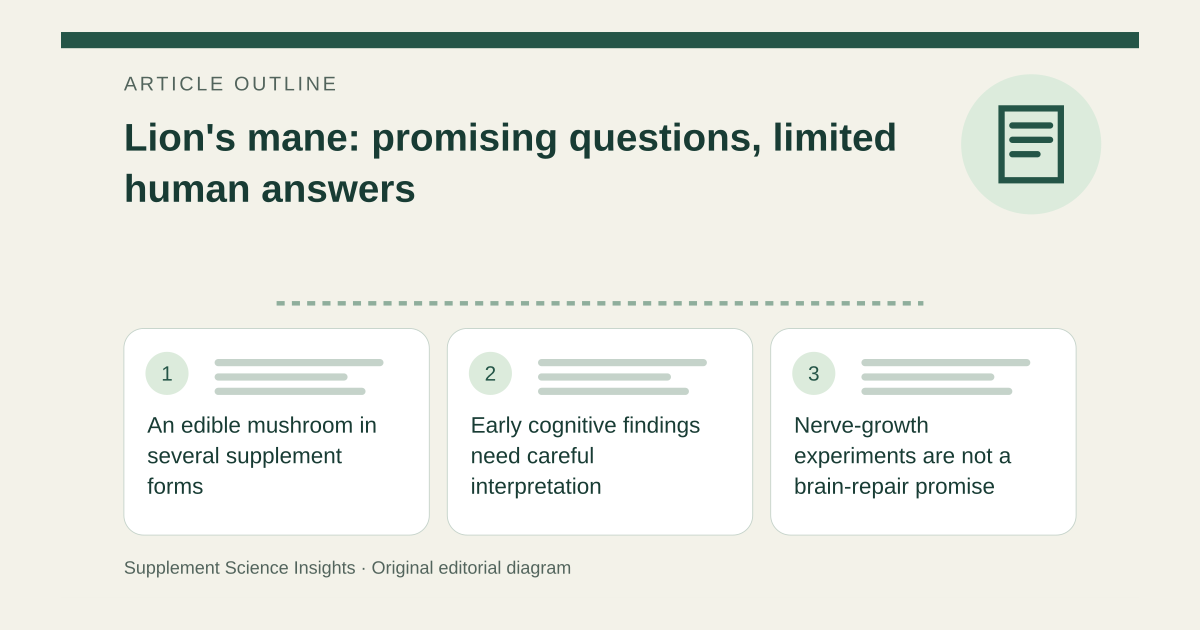
An edible mushroom in several supplement forms
Lion's mane is the mushroom Hericium erinaceus. It is sold as food and in powders, capsules and extracts. A culinary serving and a concentrated preparation should not be treated as interchangeable exposures. [1]
For a supplement, identify the material used and the actual preparation before looking at a benefit claim. A familiar mushroom name does not establish that the contents resemble the formulation used in a published study. [1]
Early cognitive findings need careful interpretation
Memorial Sloan Kettering describes limited human research on memory, cognition and mood, with some favorable findings and some outcomes showing no benefit. The populations include people with cognitive impairment and other specific groups; these studies do not establish a universal enhancement effect in healthy adults. [1]
A subjective stress score, a cognitive test and a diagnosis such as dementia are different endpoints. Improvement in one should not be rewritten as prevention or treatment of another. The duration and size of the studies also limit what can be concluded. [1]
Nerve-growth experiments are not a brain-repair promise
Compounds from lion's mane have been investigated in preclinical nerve-growth and neuroprotection research. These experiments help frame hypotheses, but they do not prove that a retail supplement repairs human nerves or prevents neurodegenerative disease. [1]
When a claim relies on a mechanism, ask for the human outcome that connects the mechanism to the promised result. If that connection has not been established for the preparation, leave it as an open research question rather than translating it into a guarantee. [1]
Check concentrated products separately
Reported adverse effects include abdominal discomfort, nausea and rash. MSK recommends discussing supplements with a health professional, particularly when medicines or ongoing treatment are involved. Familiarity as a food does not establish safety for every concentrated extract. [1]
New or worsening memory symptoms deserve assessment rather than a supplement-only response. A product comparison cannot determine their cause, and a favorable anecdote cannot establish that delaying evaluation is reasonable. [1]
A blend is not a lion's-mane dose
Imagine a hypothetical mushroom blend lists 1,500 milligrams per serving and includes lion's mane, reishi and another mushroom without separate amounts. You know the combined weight; you do not know that it contains 500 milligrams of each or 1,500 milligrams of lion's mane.
Even a separately disclosed amount would not establish equivalence to a clinical-study preparation. Compare identity, material, formulation and the measured outcome before drawing that connection. The purpose of the table is to expose missing information, not turn an undisclosed mixture into a recommendation. No mushroom is assigned a benefit merely because it appears in the blend. Record uncertainty explicitly.
| Hypothetical disclosure | Defensible interpretation |
|---|---|
| 1,500 mg mushroom blend | Combined mass |
| Three named mushrooms | Individual quantities unknown |
| Memory claim | Needs relevant human evidence for the preparation |
Sources for this article
- Memorial Sloan Kettering — Lion's Mane Mushroom
Source consulted: 2026-09-17. This is a reference resource, not a claim that we conducted the studies or tested a product.