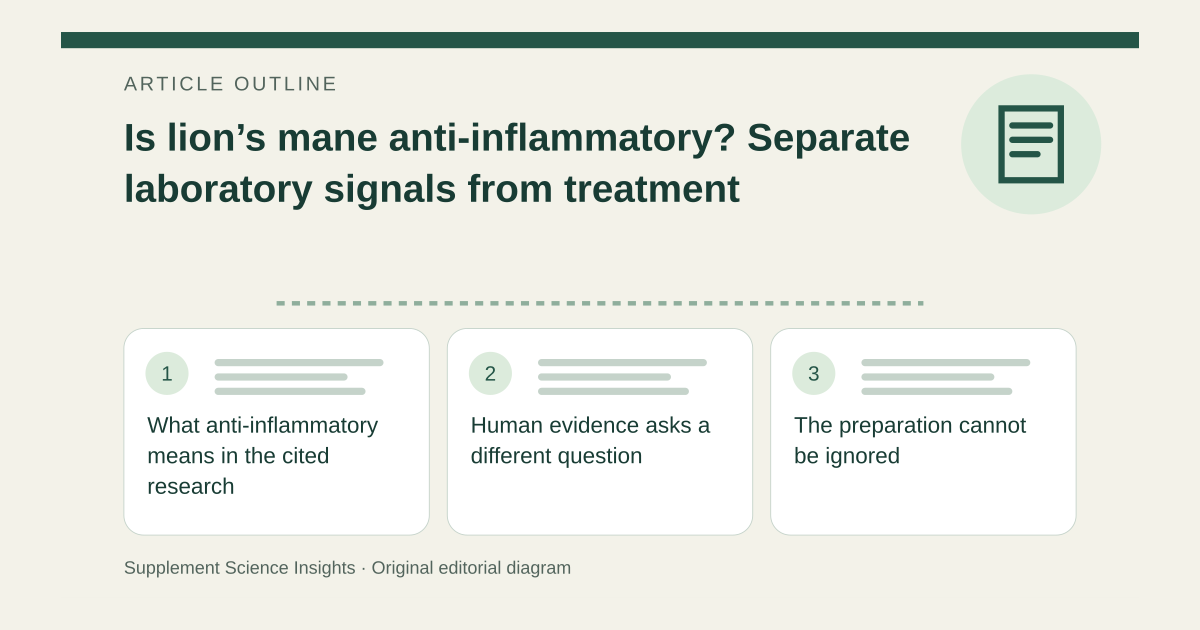
What anti-inflammatory means in the cited research
MSK describes anti-neuroinflammatory and related effects in experimental models. A change in a cell signal or an animal model can help researchers choose a hypothesis, but it is not a clinical demonstration that a person’s arthritis, bowel disease or systemic inflammation improves. [1]
Human evidence asks a different question
The clinical findings summarized by MSK largely concern cognition, mood and limited microbiome research. They do not establish lion’s mane as a broadly effective anti-inflammatory medicine. A study measuring one outcome cannot automatically support an unrelated disease claim. [1]
The preparation cannot be ignored
Fruiting body, mycelium and processed extracts can contain different components. OPSS notes that mushroom supplement composition varies with production and processing. Neither a dried culinary serving nor a generic blend can simply inherit the result of an isolated-compound experiment. [2]
Inflammation is not a single self-treatment target
If pain, swelling or a test result is driving the question, discuss the underlying condition and appropriate monitoring with a clinician. The inspected evidence does not provide a universal lion’s mane dose or a target reduction in inflammatory markers. Adverse effects such as nausea or rash remain possible. [1][3]
Check what the advertised result measured
Imagine a label citing reduced inflammatory signaling in cultured cells. Ask whether people with your condition experienced a meaningful improvement using the same preparation. Without that link, the result explains scientific interest rather than an expected personal treatment effect. [1][2]
| Evidence | What it can show |
|---|---|
| Cell pathway | Mechanistic possibility |
| Animal model | Preclinical activity |
| Relevant human outcome | Needed for a treatment claim |
Sources for this article
- Lion's Mane Mushroom | Memorial Sloan Kettering Cancer Center
Source consulted: 2026-09-21. This is a reference resource, not a claim that we conducted the studies or tested a product. - Mushroom Dietary Supplements
Source consulted: 2026-09-21. This is a reference resource, not a claim that we conducted the studies or tested a product. - Dietary Supplements: What You Need to Know
Source consulted: 2026-09-21. This is a reference resource, not a claim that we conducted the studies or tested a product.