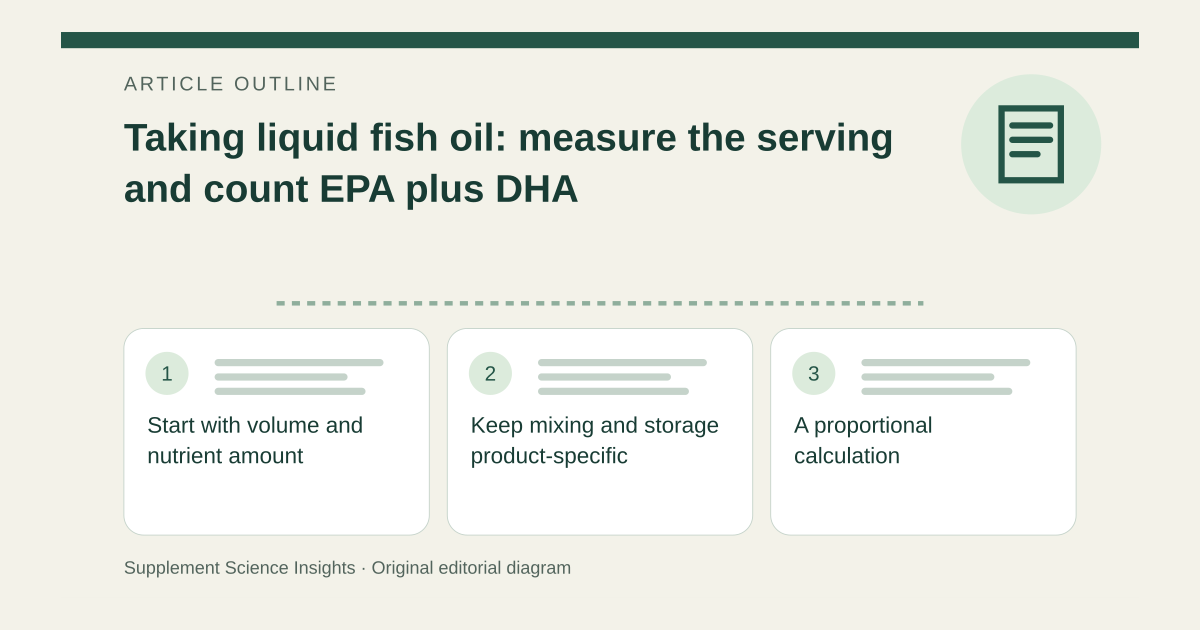
Start with volume and nutrient amount
Read how many milliliters define a serving, then find the EPA and DHA listed for that serving. Those amounts are not necessarily equal to the total fish-oil mass. Use a suitable marked measure and follow any product instructions about mixing or taking with food. [1][2]
Keep mixing and storage product-specific
A permitted food or drink can make a liquid easier to take, but the whole measured portion needs to be consumed to obtain the calculated amount. Follow the bottle’s refrigeration and after-opening instructions. A general fish-oil category cannot supply a reliable storage period for every liquid preparation. [1]
A proportional calculation
Imagine 5 mL supplies 500 mg EPA plus DHA. A 2.5 mL portion supplies approximately 250 mg if the product is uniform and handled as directed. That calculation translates a label; it does not identify the appropriate dose for a health condition. Do not substitute the liquid for a prescribed omega-3 medicine without review. [2]
| Illustration | Interpretation |
|---|---|
| 5 mL gives 500 mg | Hypothetical concentration |
| 2.5 mL gives 250 mg | Half the stated amount |
| Unmeasured pour | Uncertain exposure |
Sources for this article
- Questions and Answers on Dietary Supplements | FDA
Source consulted: 2026-09-20. This is a reference resource, not a claim that we conducted the studies or tested a product. - Omega-3 Fatty Acids - Health Professional Fact Sheet
Source consulted: 2026-09-20. This is a reference resource, not a claim that we conducted the studies or tested a product.