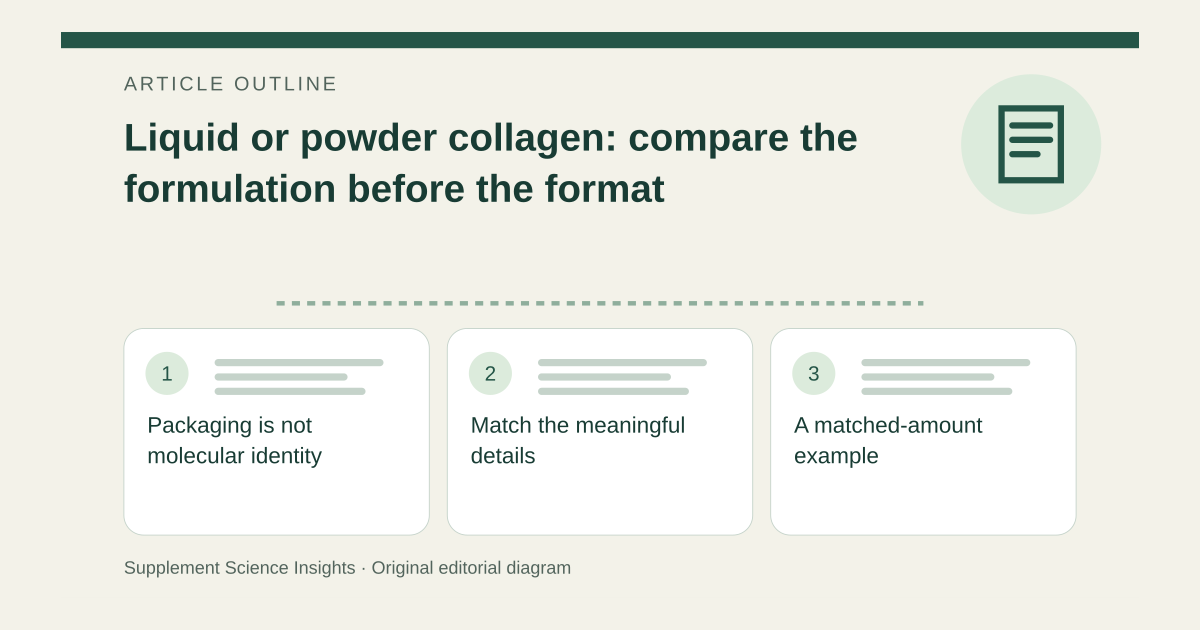
Packaging is not molecular identity
Native collagen, gelatin and hydrolyzed collagen differ in structure and processing. Either the amount or the form can change between products sold as collagen. A comparison based only on liquid versus powder overlooks these differences; the composition review does not establish a universal winner between retail formats. [1]
Match the meaningful details
Compare source species, collagen form, amount per intended serving, other ingredients, storage and cost. A larger liquid volume may simply include more water. An absorption claim needs evidence for the actual preparations and relevant outcome; a mechanistic discussion about peptides does not prove better results for a bottle sold today. [1]
A matched-amount example
Imagine a liquid serving declares 5 g hydrolyzed collagen and a powder serving declares 10 g. Two liquid servings would match the declared 10 g amount, while also doubling the liquid product’s other ingredients and cost per serving. That arithmetic does not prove identical peptide composition or clinical effects. It is not a recommendation to double the label directions. [1]
| Hypothetical comparison | Interpretation |
|---|---|
| One liquid serving: 5 g | Declared collagen amount |
| One powder serving: 10 g | Twice that amount |
| Equal grams | Does not establish identical peptide profiles |
Sources for this article
- Collagen Supplementation for Joint Health: The Link between Composition and Scientific Knowledge - PMC
Source consulted: 2026-09-20. This is a reference resource, not a claim that we conducted the studies or tested a product.