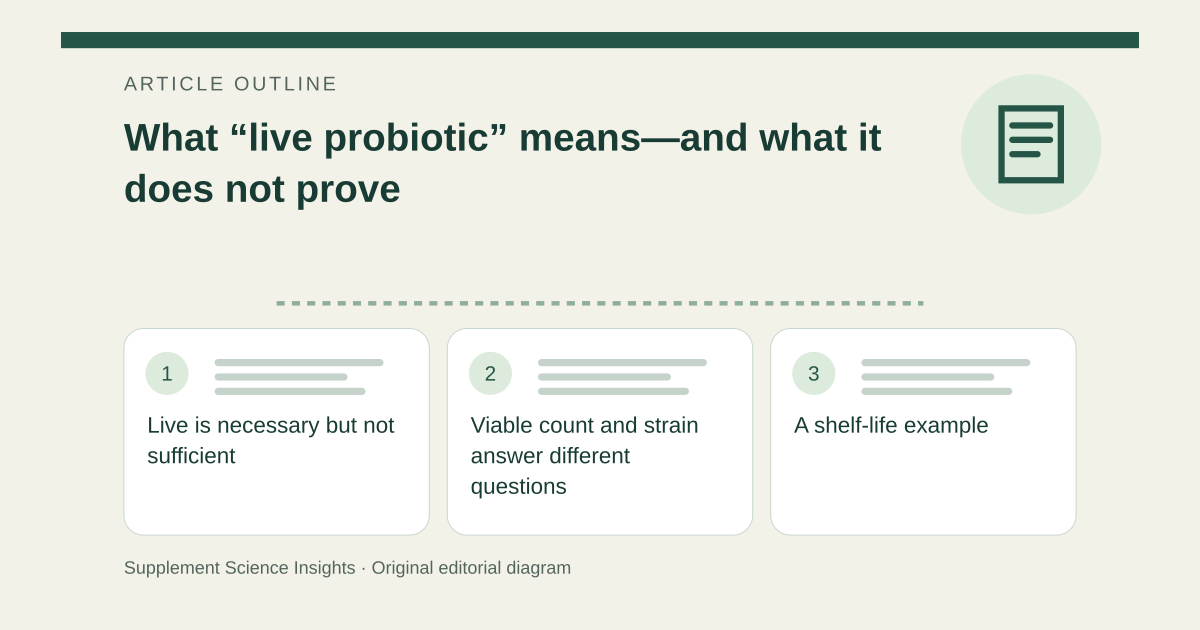
Live is necessary but not sufficient
A probiotic is a live microorganism that confers a health benefit when administered in an adequate amount. Calling a culture live establishes only one part of that definition. A microorganism can be alive without having demonstrated a useful health effect for the condition someone wants to address. [1]
Viable count and strain answer different questions
Colony-forming units, or CFU, express viable microorganisms under the relevant counting conditions. A higher CFU count does not necessarily make a product more effective. The organism’s strain identity and evidence for the intended use are needed as well; findings for one strain cannot simply be assigned to every organism with a related name. [1]
A shelf-life example
Imagine two labels show 10billionCFU. One refers to manufacture, while the other guarantees the count through expiry under its stated storage conditions. Those statements describe different points in time. Follow the product’s storage directions and check what the guarantee covers; neither label alone supplies evidence of a health benefit. [1]
| Hypothetical statement | Question still unanswered |
|---|---|
| Live cultures | Which strain and demonstrated benefit? |
| 10billionCFU at manufacture | How many remain through expiry? |
| Count guaranteed through expiry | Were storage conditions followed, and is the use supported? |
Sources for this article
- Probiotics - Health Professional Fact Sheet
Source consulted: 2026-09-20. This is a reference resource, not a claim that we conducted the studies or tested a product.