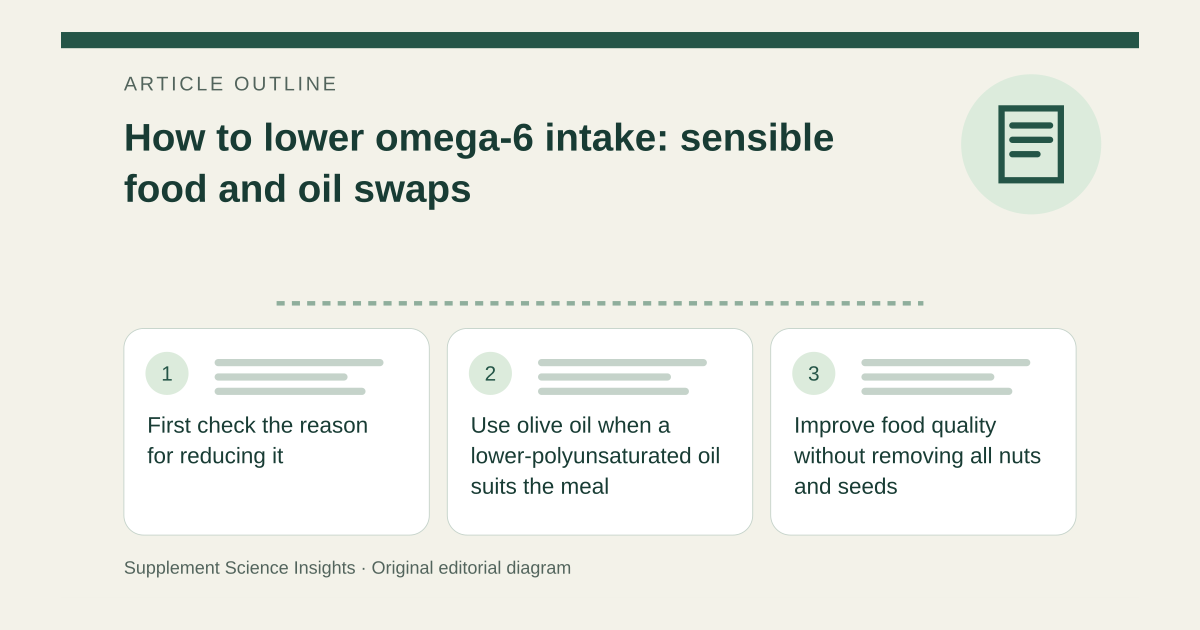
First check the reason for reducing it
Harvard’s review does not support using the omega-6-to-omega-3 ratio alone as a health score. Controlled feeding research does not establish that ordinary omega-6 intake raises inflammatory markers. A social-media target is not automatically a medically necessary restriction. [1]
Use olive oil when a lower-polyunsaturated oil suits the meal
Olive oil is predominantly monounsaturated, while conventional corn and sunflower oils contain more polyunsaturated fat. Replacing some of those oils with olive oil can change the fat mix. This is a culinary option, not proof that the original oils are toxic. [2]
Improve food quality without removing all nuts and seeds
Reduce reliance on heavily processed snack foods if they crowd out balanced meals. Include appropriate omega-3 sources such as fish, walnuts or flax according to your needs. Do not replace unsaturated oils wholesale with butter or coconut oil just to lower omega-6. [1][2]
Evaluate the whole swap
Imagine a person swaps a fried snack for fruit and yogurt, while retaining nuts in other meals. The change affects several nutrients and energy intake, so benefits cannot be assigned solely to lower omega-6. A varied diet is more useful than chasing a ratio at every meal. [1][2]
| Question | Practical interpretation |
|---|---|
| Olive oil substitution | Changes fat mix |
| Butter instead of all oils | Raises other concerns |
| Removing nuts | May discard useful foods |
| More balanced meals | Broader than a ratio |
Sources for this article
- Omega-3 Fatty Acids: An Essential Contribution • The Nutrition Source
Source consulted: 2026-09-21. This is a reference resource, not a claim that we conducted the studies or tested a product. - Types of Fat • The Nutrition Source
Source consulted: 2026-09-21. This is a reference resource, not a claim that we conducted the studies or tested a product.