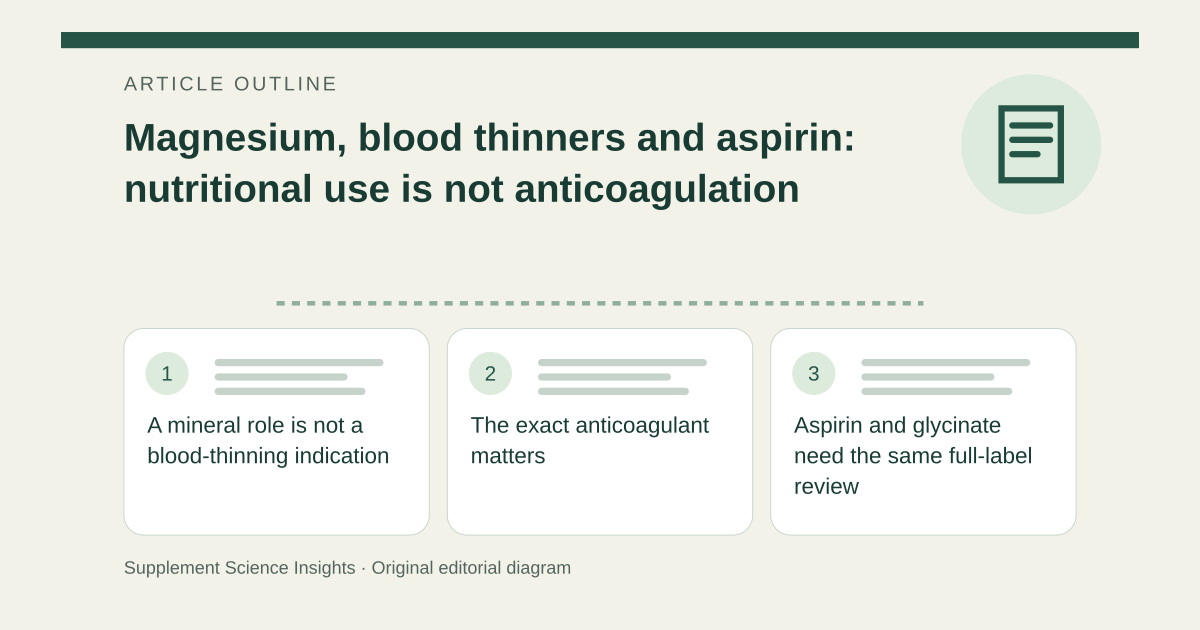
A mineral role is not a blood-thinning indication
Magnesium supports normal physiology, but the inspected nutrient guidance does not establish an oral supplement as a treatment to prevent blood clots. Warfarin is an anticoagulant, while low-dose aspirin is used for its effect on clot formation in appropriate patients. They are not interchangeable with magnesium. [1][2][3]
The exact anticoagulant matters
NHS advises people taking warfarin to discuss new medicines and supplements with their treating team. Warfarin requires INR monitoring, and its advice should not be applied as though every anticoagulant uses the same monitoring test or has an identical interaction profile. Review the actual prescription. [2]
Aspirin and glycinate need the same full-label review
The inspected aspirin guidance does not give universal approval or a universal spacing rule for magnesium glycinate. Aspirin can cause stomach irritation and bleeding, while magnesium can cause gastrointestinal effects and toxicity with excessive exposure. A glycinate blend may contain additional ingredients that change the assessment. [3][1]
Do not confuse compatibility with replacement
Absence of a named interaction on a short information page is not proof that an unspecified combination is safe. Equally, magnesium should not be portrayed as a proven blood thinner merely because it is linked to cardiovascular physiology. Keep prescribed clot-prevention treatment in place while checking the proposed supplement. [2][3][1]
Bleeding symptoms require clinical attention
Vomiting blood, black tar-like stool or other significant bleeding needs prompt medical assessment. Imagine a person taking warfarin starts a magnesium blend containing several herbs: the review must include every ingredient and any needed monitoring, not only the mineral on the front label. [2][3]
| Detail | Reason |
|---|---|
| Exact anticoagulant or aspirin regimen | Different medicines and monitoring |
| Complete supplement label | Co-ingredients can matter |
| Elemental magnesium and kidney function | Defines mineral safety context |
| Bleeding symptoms | Need prompt assessment |
Sources for this article
- Magnesium - Health Professional Fact Sheet
Source consulted: 2026-09-21. This is a reference resource, not a claim that we conducted the studies or tested a product. - Warfarin: medicine used to prevent and treat blood clots - NHS
Source consulted: 2026-09-21. This is a reference resource, not a claim that we conducted the studies or tested a product. - Aspirin: medicine for pain relief or preventing blood clots - NHS
Source consulted: 2026-09-21. This is a reference resource, not a claim that we conducted the studies or tested a product.