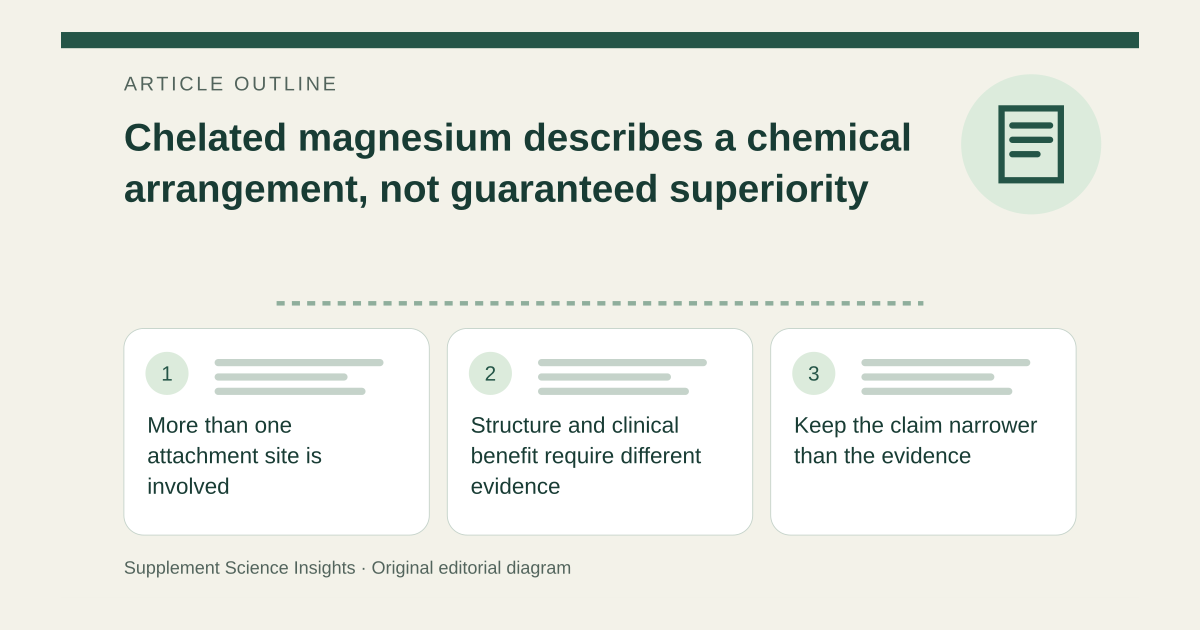
More than one attachment site is involved
IUPAC defines chelation in terms of a ligand interacting with a central atom at multiple separate binding sites. The definition describes a structure, not a clinical performance rating. [1][2]
For a magnesium product, the named compound is more informative than the unqualified word chelated. It allows a reader to ask what preparation was actually studied and whether that study measured absorption or a health outcome. [1][2]
Structure and clinical benefit require different evidence
NIH ODS describes differences in absorption between magnesium preparations, but no single chemistry word establishes superiority for every use. An absorption finding would still not prove a better sleep or anxiety outcome. [2]
The elemental magnesium amount also differs from the weight of the entire compound. Compare declared elemental amounts and the actual formulation, while considering tolerability and medicines that can interact with magnesium. [2]
Keep the claim narrower than the evidence
Imagine a product is accurately described as chelated. That confirms a chemical description only; it does not show that the product outperformed another preparation in a clinical trial.
| Detail | Interpretation |
|---|---|
| Chelation | Chemical arrangement |
| Absorption study | Measures uptake |
| Symptom trial | Tests a different outcome |
Sources for this article
- IUPAC - chelation (C01012)
Source consulted: 2026-09-19. This is a reference resource, not a claim that we conducted the studies or tested a product. - Magnesium - Health Professional Fact Sheet
Source consulted: 2026-09-19. This is a reference resource, not a claim that we conducted the studies or tested a product.