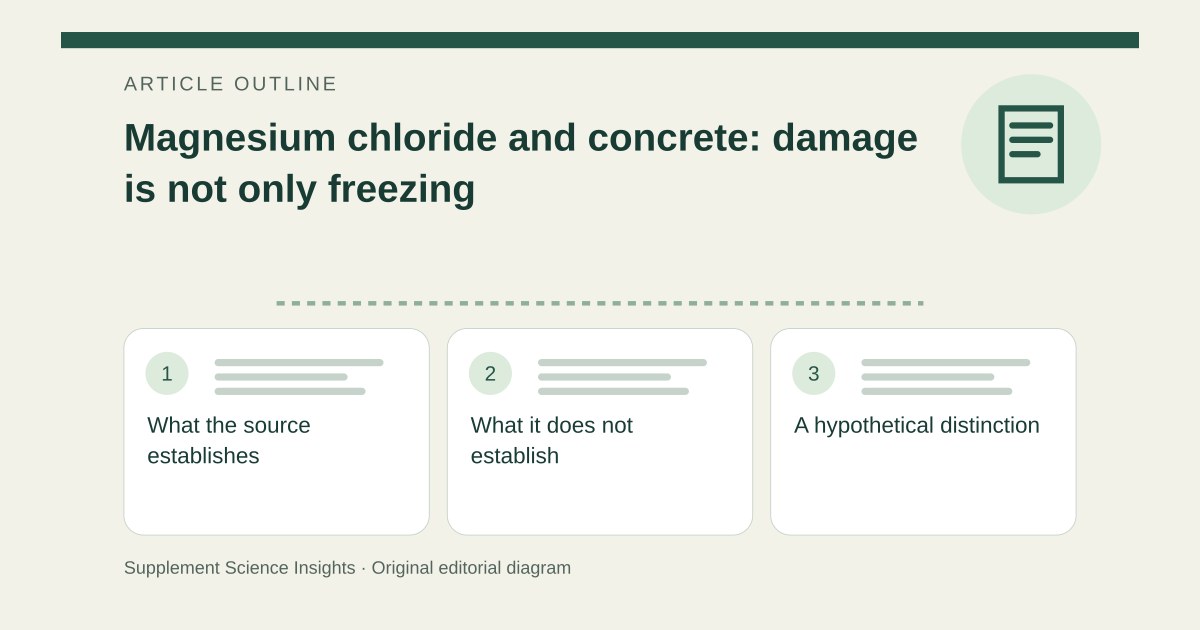
What the source establishes
The study examined mortar and cement chemistry rather than measuring the service life of a driveway. Magnesium chloride could react with cement constituents and generate calcium chloride and other phases. [1]
At lower tested concentrations, short freeze-thaw exposure produced ice-related damage. At higher concentrations, chemical reactions were the likely damage pathway even at room temperature. Rapid reactions also reduced subsequent fluid ingress. [1]
What it does not establish
Reduced ingress did not mean the material was undamaged. These laboratory findings cannot provide a universal safe concentration, a field-life prediction or a rebar-corrosion estimate. Funding and conflicts were not established from the retrieved abstract. [1]
A hypothetical distinction
Imagine a surface takes up less liquid after a reaction. That observation alone cannot distinguish protection from reaction products associated with damage.
| Detail | Interpretation |
|---|---|
| Lower liquid uptake | Not automatically protection |
| Laboratory mortar | Defined test conditions |
| Field service life | Not directly measured |
Sources for this article
- Damage Development in Cementitious Materials Exposed to MgCl2 Deicing Salt | NIST
Source consulted: 2026-09-19. This is a reference resource, not a claim that we conducted the studies or tested a product.