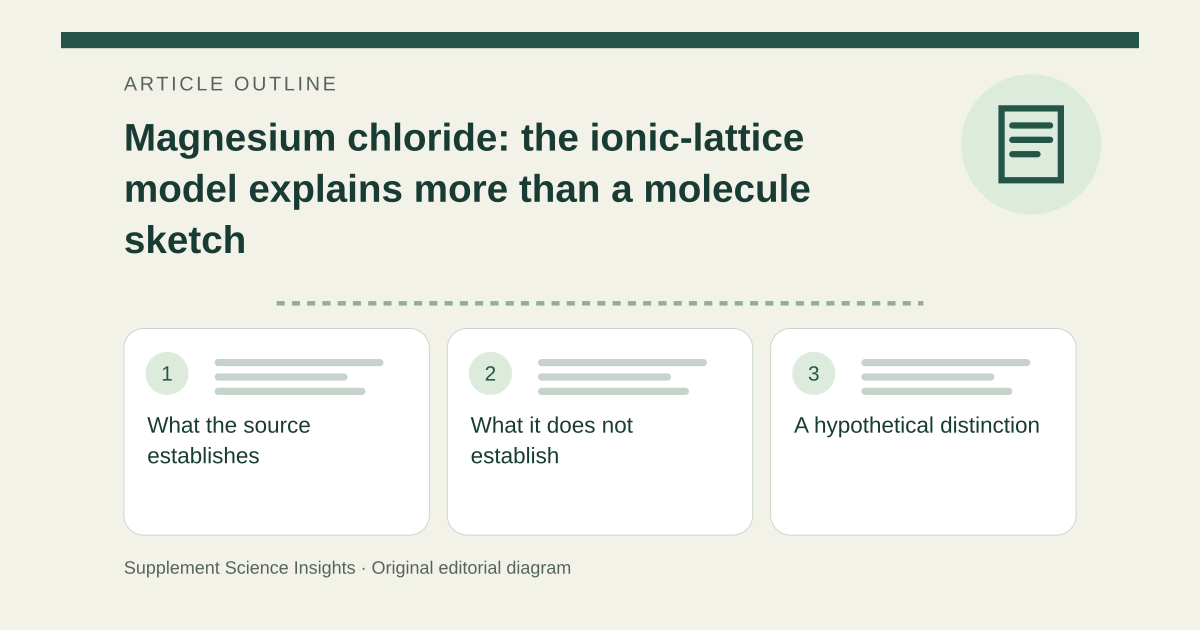
What the source establishes
The Royal Society of Chemistry explains lattice stability through ionic charge density. Magnesium ions have the same charge as calcium ions but are smaller, producing stronger interactions in the comparison presented. [1]
The resource contrasts magnesium chloride with calcium chloride and also explains hydration: water molecules surround dissolved ions. Breaking lattice interactions and hydrating ions are different energetic contributions. [1]
What it does not establish
A stronger lattice alone does not determine overall solubility because several effects operate together. Nor does the comparison rank clinical absorption or identify a suitable dose. A chemical model answers a different question from a human trial. [1]
A hypothetical distinction
Imagine two salts differ in both lattice strength and hydration. Looking at only one contribution can give an incomplete prediction of dissolution.
| Detail | Interpretation |
|---|---|
| Lattice | Interactions in a solid |
| Hydration | Interactions with water |
| Clinical benefit | Separate evidence needed |
Sources for this article
- Scaffolding explanations
Source consulted: 2026-09-19. This is a reference resource, not a claim that we conducted the studies or tested a product.