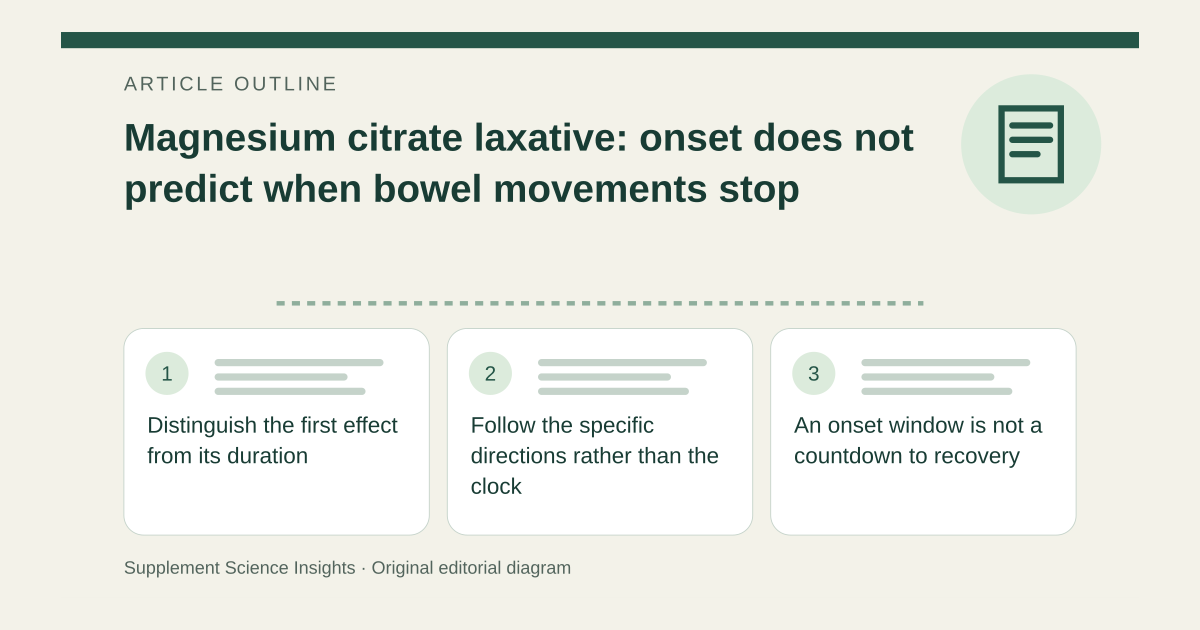
Distinguish the first effect from its duration
MedlinePlus gives the 30-minute-to-six-hour interval for a bowel movement after taking magnesium citrate. Individual responses vary, and the description does not provide a universal time when all bowel movements will stop. [1]
The guidance concerns a saline laxative preparation. A nutritional magnesium capsule should not be assumed to have the same dose or effect merely because citrate appears in its ingredient name. [1]
Follow the specific directions rather than the clock
Take the preparation as directed and do not repeat or increase the dose simply because the expected effect seems delayed. MedlinePlus advises against use beyond one week unless directed by a clinician. [1]
The label and pharmacist can clarify the intended use and liquid instructions for the exact product. A full bottle is a package size, not automatically an appropriate individual dose. [1]
An onset window is not a countdown to recovery
Imagine a bowel movement occurs two hours after a laxative dose. That falls within the described onset window, but it does not establish that further effects must end four hours later.
| Detail | Interpretation |
|---|---|
| Onset | First bowel movement |
| Duration | Not fixed by the onset range |
| Bottle size | Not a personal dose |
Sources for this article
- Magnesium Citrate: MedlinePlus Drug Information
Source consulted: 2026-09-17. This is a reference resource, not a claim that we conducted the studies or tested a product.