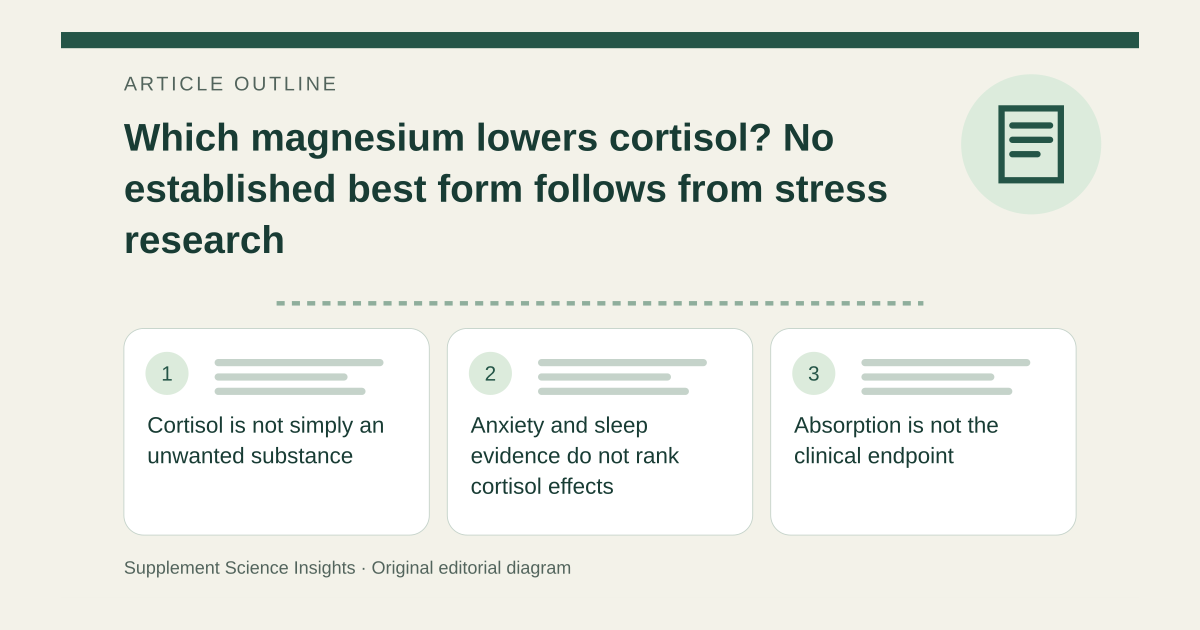
Cortisol is not simply an unwanted substance
Cortisol supports blood pressure, blood glucose, metabolism and the response to inflammation. The clinical question is not whether to lower it as far as possible. Persistently excessive exposure, including from glucocorticoid medicines, has a different significance from ordinary day-to-day stress. [1]
Anxiety and sleep evidence do not rank cortisol effects
A 2024 systematic review of magnesium for anxiety and sleep described heterogeneous studies and uncertainty about optimal formulation. Improvements in a symptom questionnaire cannot be assumed to demonstrate lower cortisol, and they do not establish a winning cortisol-lowering salt. [2]
Absorption is not the clinical endpoint
Magnesium forms differ in composition and absorption. Those differences do not by themselves show which form changes cortisol appropriately or improves outcomes in someone with an endocrine disorder. No cortisol-treatment dose follows from the NIH nutrient fact sheet. [3][1]
Testing requires context
Symptoms attributed online to high cortisol can have other explanations. NIDDK describes appropriately timed urine, saliva or blood tests and often more than one test when evaluating Cushing syndrome. A feeling of stress or one poorly contextualized measurement is not enough to choose an endocrine treatment. [1]
Review medicines without abruptly stopping them
Do not abruptly stop prescribed glucocorticoids to lower cortisol exposure; changes require medical guidance. Imagine a person feels calmer after glycinate and assumes an abnormal cortisol condition is resolved: symptom relief alone does not establish that conclusion. Keep the nutritional and endocrine decisions separate. [1][3]
| Observation | Limit |
|---|---|
| Feeling calmer | Not a cortisol measurement |
| Better absorption | Not proof of endocrine benefit |
| Suspected persistent excess | Requires appropriate testing |
| Prescribed glucocorticoid use | Changes need clinical guidance |
Sources for this article
- Cushing's Syndrome - NIDDK
Source consulted: 2026-09-21. This is a reference resource, not a claim that we conducted the studies or tested a product. - Examining the Effects of Supplemental Magnesium on Self-Reported Anxiety and Sleep Quality: A Systematic Review - PMC
Source consulted: 2026-09-21. This is a reference resource, not a claim that we conducted the studies or tested a product. - Magnesium - Health Professional Fact Sheet
Source consulted: 2026-09-21. This is a reference resource, not a claim that we conducted the studies or tested a product.