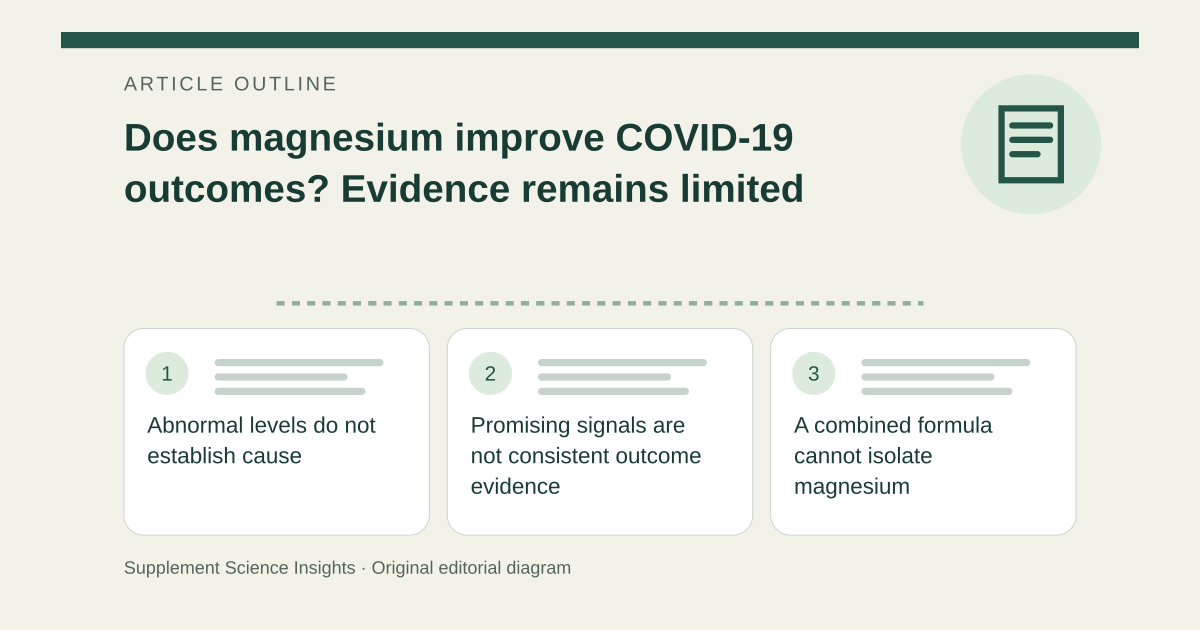
Abnormal levels do not establish cause
The NIH ODS magnesium section explains that both low and high levels have been observed during COVID-19. Critical illness, kidney function, medicines and measurement issues can contribute. Such findings do not show that low dietary intake caused a severe infection. [1]
Promising signals are not consistent outcome evidence
ODS summarizes small studies, including combinations with other nutrients and a small hospitalized-adult trial with some oxygen-related findings but no shorter hospital stay. These results do not establish a general home-treatment protocol. The summary here is limited to the inspected official source section, not a new analysis of the original trials. [1]
A combined formula cannot isolate magnesium
When vitamin D, B12 or other ingredients are given with magnesium, any observed difference cannot be assigned to magnesium alone. Differences in patient selection and concurrent care further limit what small observational studies establish. [1]
Do not delay assessment or treatment
NCCIH states that research has not clearly shown that dietary supplements prevent COVID-19 or reduce its severity. Contact a health professional about appropriate treatment, including when symptoms are mild and risk factors are present. A supplement should not replace that assessment. [2]
Replacement is a different indication
Imagine a hospitalized patient receives magnesium because a clinician identifies an electrolyte problem. That is not proof that everyone with COVID-19 should use the same amount. Kidney function, other medicines and the actual deficiency guide replacement, and excess magnesium can be harmful. [3][1]
| Evidence | Limit |
|---|---|
| Low magnesium during illness | May reflect illness rather than cause it |
| Multi-nutrient combination | Cannot isolate magnesium |
| One improved outcome | Not proof of broad clinical benefit |
| Clinical deficiency replacement | Not a universal infection regimen |
Sources for this article
- Dietary Supplements in the Time of COVID-19: Magnesium
Source consulted: 2026-09-21. This is a reference resource, not a claim that we conducted the studies or tested a product. - COVID-19 Symptoms and Complementary Approaches: What You Need To Know | NCCIH
Source consulted: 2026-09-21. This is a reference resource, not a claim that we conducted the studies or tested a product. - Magnesium - Health Professional Fact Sheet
Source consulted: 2026-09-21. This is a reference resource, not a claim that we conducted the studies or tested a product.