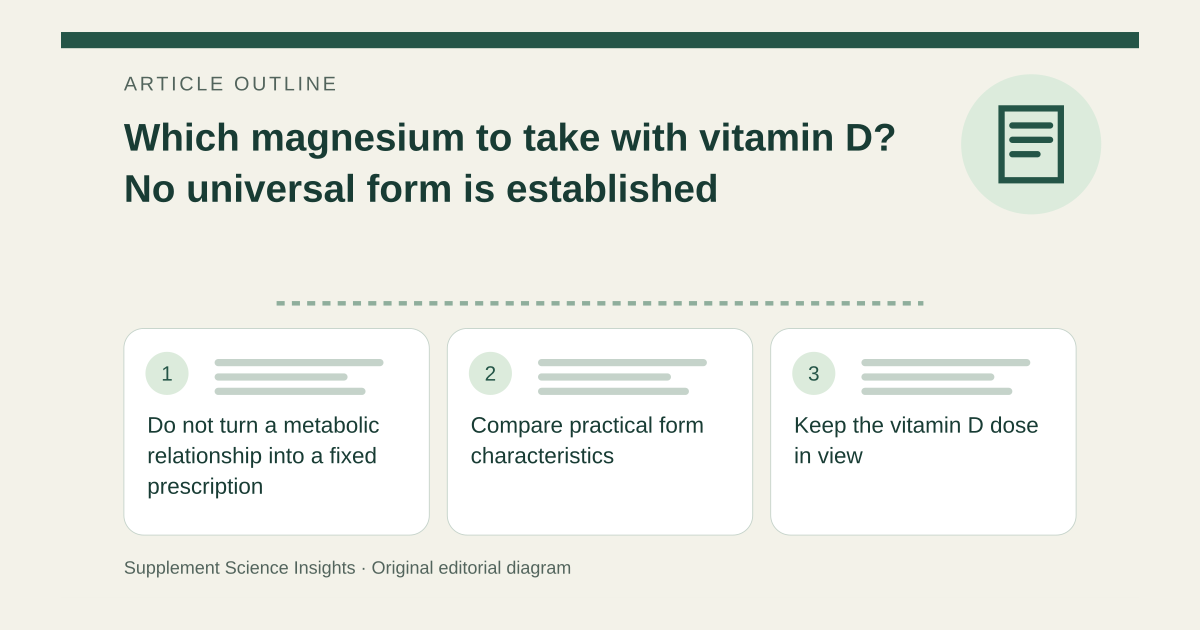
Do not turn a metabolic relationship into a fixed prescription
Magnesium and vitamin D both participate in normal physiology. That relationship does not establish that every vitamin D user needs an extra magnesium supplement or that one magnesium salt uniquely activates all vitamin D products. The cited references do not set a universal form-and-ratio rule. [1][2]
Compare practical form characteristics
ODS describes absorption differences among magnesium forms, along with gastrointestinal effects and medicine interactions. Those considerations can inform a product choice when supplementation is needed. They do not prove that the form with a particular marketing claim improves vitamin D-related clinical outcomes more than all alternatives. [1]
Keep the vitamin D dose in view
Imagine someone adds magnesium to make a high vitamin D intake feel safer. Magnesium does not remove the risks of excessive vitamin D. Review both intakes and the reason for using them, especially when testing or treatment is being supervised. One nutrient should not be used as permission to take an arbitrary amount of another. [2][1]
| Example | Interpretation |
|---|---|
| Vitamin D use | Does not select one magnesium salt |
| Tolerance and formulation | Practical selection factors |
| Excess vitamin D | Not neutralized by adding magnesium |
Sources for this article
- Magnesium - Health Professional Fact Sheet
Source consulted: 2026-09-20. This is a reference resource, not a claim that we conducted the studies or tested a product. - Vitamin D - Health Professional Fact Sheet
Source consulted: 2026-09-20. This is a reference resource, not a claim that we conducted the studies or tested a product.