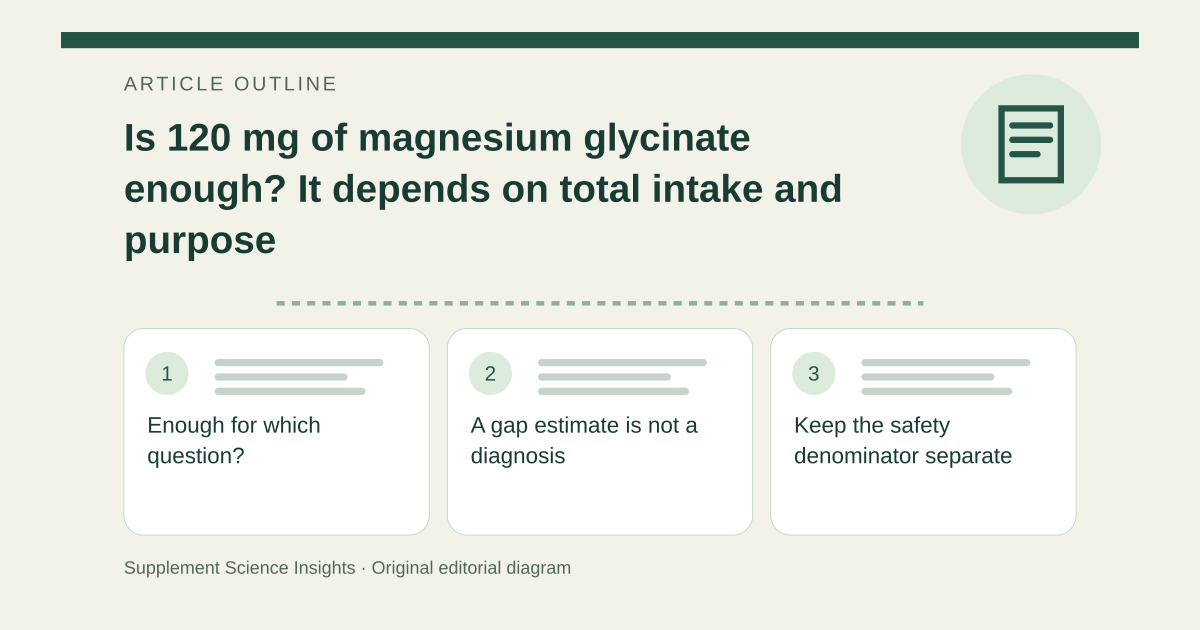
Enough for which question?
First establish whether 120 mg refers to elemental magnesium or the entire glycinate compound. The nutrient amount belongs in intake calculations. General adult RDAs range from 310 to 420 mg/day, depending on age and sex, and include food. A supplement does not have to equal that whole amount when the diet supplies the rest. [1]
A gap estimate is not a diagnosis
Suppose a hypothetical food record supplies 200 mg magnesium and a supplement contributes 120 mg elemental magnesium. The estimated total is 320 mg. That arithmetic can inform nutritional planning but cannot diagnose deficiency, measure absorption or prove a symptom will respond. Different food records and life stages produce different conclusions. [1]
Keep the safety denominator separate
The usual adult upper limit is 350 mg daily from supplements and medications, excluding natural food sources. Being below it does not guarantee that a product is appropriate with kidney disease or interacting medicines. If the purpose is treatment of documented deficiency, the clinician’s assessment and follow-up matter more than a generic 120 mg rule. [1]
| Hypothetical source | Elemental magnesium |
|---|---|
| Foods | 200 mg |
| Supplement | 120 mg |
| Estimated total | 320 mg; not an absorption measurement |
Sources for this article
- Magnesium - Health Professional Fact Sheet
Source consulted: 2026-09-20. This is a reference resource, not a claim that we conducted the studies or tested a product.