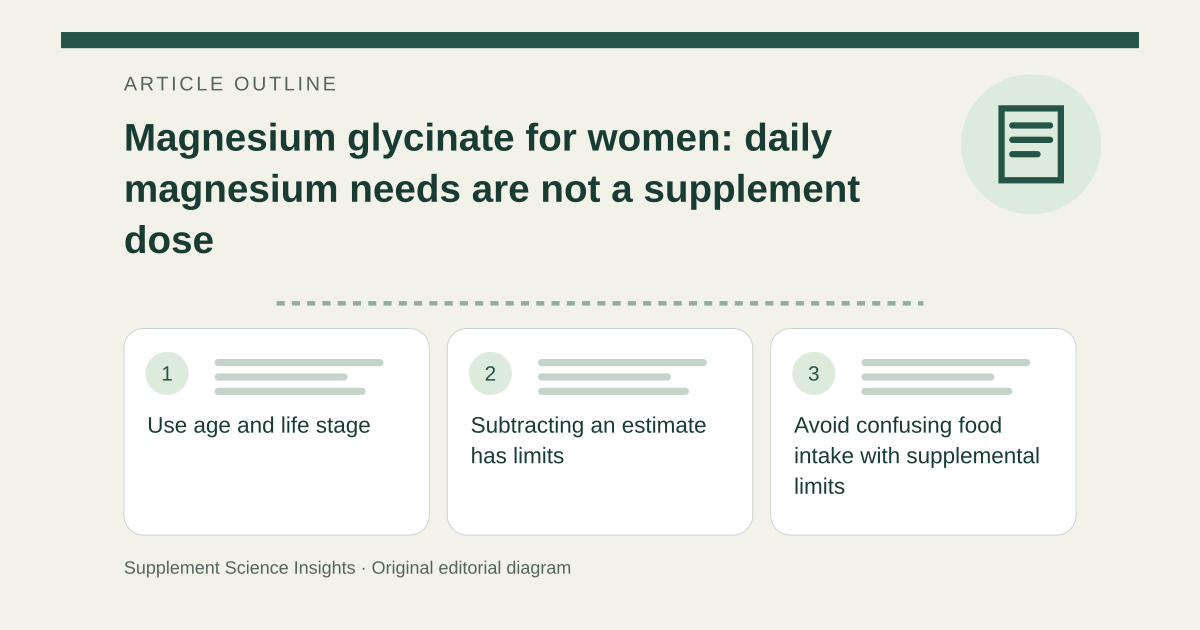
Use age and life stage
NIH ODS lists magnesium RDAs of 310 mg/day for women 19–30 and 320 mg for women 31 and older. Pregnancy increases the reference to 350 mg at 19–30 and 360 mg at 31–50; lactation at those ages uses 310 and 320 mg. These are total dietary requirements, not amounts everyone should take as glycinate. [1]
Subtracting an estimate has limits
Imagine a 35-year-old nonpregnant woman’s food record estimates 250 mg/day. Compared with the 320 mg RDA, the arithmetic difference is 70 mg. The estimate is not a diagnosed deficiency or an instruction to buy a 70 mg tablet: usual intake varies, food changes may help, and clinical circumstances can change the assessment. [1]
Avoid confusing food intake with supplemental limits
The adult upper limit of 350 mg applies to magnesium from supplements and medicines, not natural food magnesium. Check elemental magnesium on the panel rather than the glycinate compound weight. Kidney impairment and interacting medicines require additional assessment; the general reference values do not establish a treatment for every symptom in women. [1]
| Hypothetical nutritional review | Amount |
|---|---|
| Age 35, nonpregnant RDA | 320 mg total/day |
| Estimated food intake | 250 mg/day |
| Arithmetic difference | 70 mg; not a prescribed supplement dose |
Sources for this article
- Magnesium - Health Professional Fact Sheet
Source consulted: 2026-09-20. This is a reference resource, not a claim that we conducted the studies or tested a product.