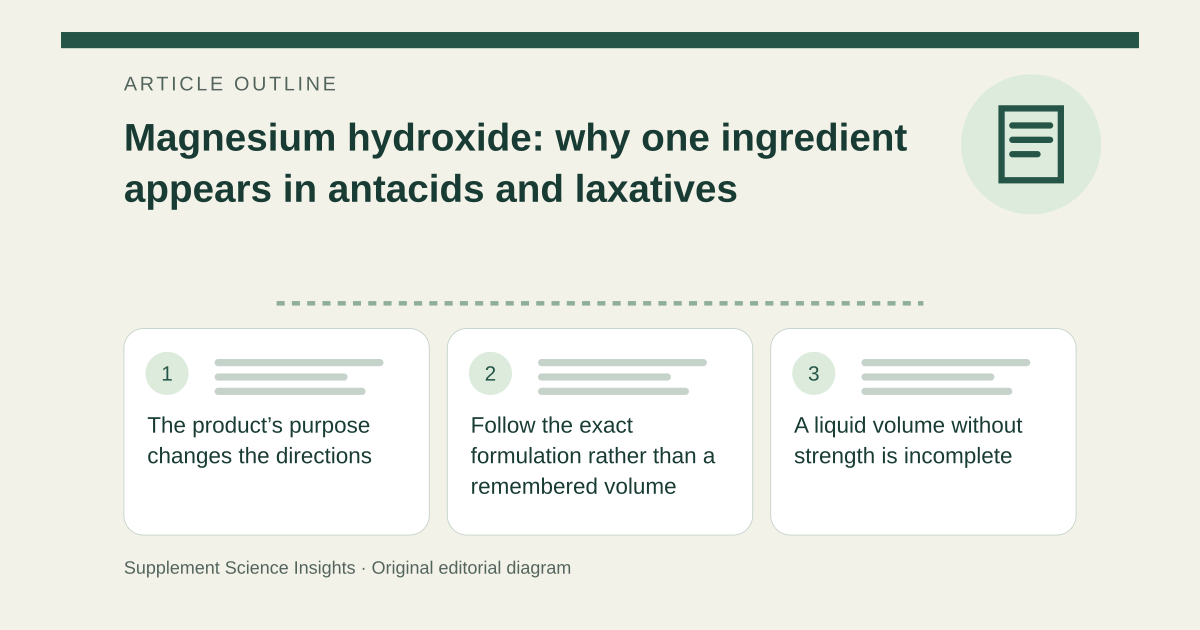
The product’s purpose changes the directions
Magnesium hydroxide is a saline laxative used for occasional constipation on a short-term basis. MedlinePlus explains that it retains water with the stool, helping soften stool and increase bowel movements. It also appears in antacid preparations for heartburn, acid indigestion and upset stomach. [1]
The same ingredient name does not make the antacid and laxative directions interchangeable. Combination products may contain other active ingredients, and tablets and liquids can have different strengths and serving definitions. [1]
Follow the exact formulation rather than a remembered volume
Read whether the amount refers to a tablet, a measured liquid volume or another serving. MedlinePlus instructs users to shake oral suspensions and follow the label or prescribed directions. A volume remembered from a previous bottle is not reliable if the concentration changed. [1][2]
The medicine is not intended as a routine way to maximize nutritional magnesium. Its bowel effect and duration of use need to fit the indication, not an RDA calculation. [1][2]
A liquid volume without strength is incomplete
Imagine two fictional bottles both say “magnesium hydroxide,” but one has a different concentration or additional active ingredients. A note saying only “one spoonful” does not provide enough information to compare them. Record the strength, measured volume, other ingredients and reason for use.
This example deliberately supplies no dose: an incomplete label cannot support a safe conversion between products.
| Observation | Interpretation |
|---|---|
| Ingredient name only | Insufficient for a dose comparison |
| Strength and measured volume | Define the amount in a liquid serving |
| Other actives and indication | May change the appropriate directions |
Kidney disease and other medicines need review
MedlinePlus advises telling the clinician about kidney disease, abdominal pain, nausea, vomiting, pregnancy and a persistent change in bowel habits. It also gives medication-spacing advice, but the pharmacist should reconcile this with the instructions for each other medicine, particularly drugs with their own specific separation requirements. [1]
Do not use magnesium hydroxide for longer than one week without medical advice. MedlinePlus directs users to stop and call the doctor immediately for blood in the stool or no bowel movement six hours after use. Do not respond by repeatedly escalating the amount. [1]
A familiar name is not a substitute for the label
Loose, watery or more frequent stools can occur, and excessive magnesium exposure can be especially hazardous when kidney clearance is impaired. The source guidance supports careful short-term use for the labeled purpose; it does not establish that every “milk of magnesia” preparation is interchangeable. [1][2]
This page is an explanation of uses and precautions, not an individualized constipation or reflux treatment plan. [1][2]
Sources for this article
- MedlinePlus — Magnesium Hydroxide
Source consulted: 2026-09-17. This is a reference resource, not a claim that we conducted the studies or tested a product. - NIH ODS — Magnesium: Health Professional Fact Sheet
Source consulted: 2026-09-17. This is a reference resource, not a claim that we conducted the studies or tested a product.