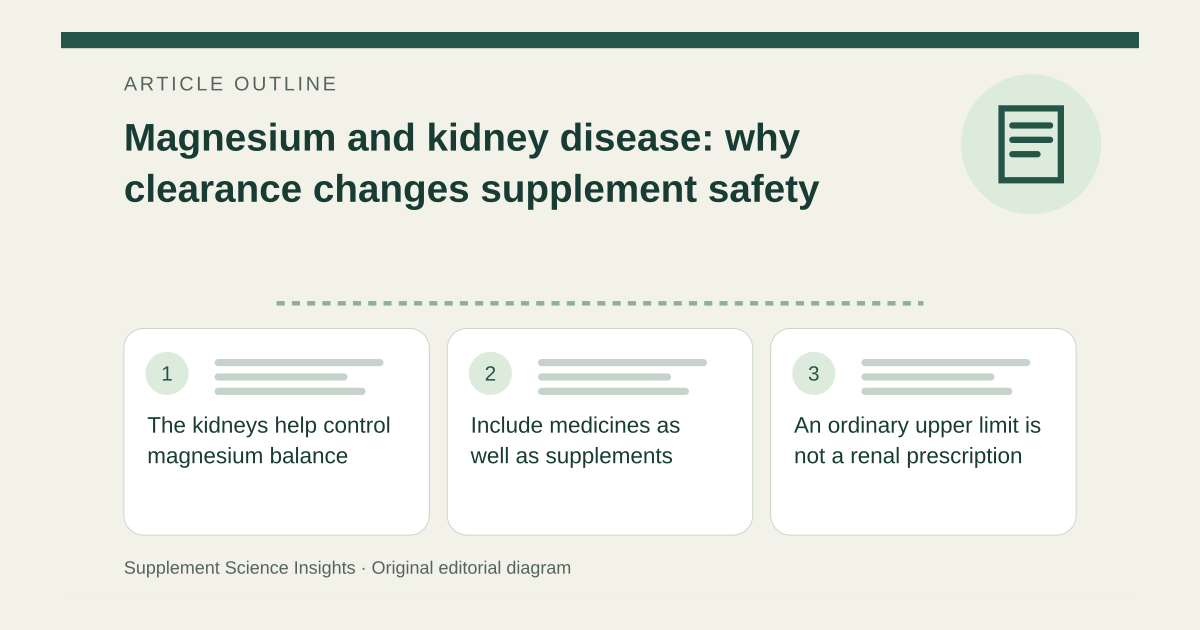
The kidneys help control magnesium balance
The kidneys regulate how much magnesium is retained and how much leaves in urine. NIH ODS explains that impaired renal function or kidney failure increases toxicity risk because excess magnesium cannot be removed as effectively. A mineral that is normally regulated well can become a problem when clearance changes. [1]
This does not mean everyone with kidney disease has high magnesium. It means the safety of adding magnesium depends on kidney function, current levels, medicines and the actual exposure rather than on the word “natural.” [1]
Include medicines as well as supplements
Magnesium can be present in antacids and laxatives, sometimes at much larger amounts than a routine nutritional supplement. A person may overlook these products when asked what supplements they take. Keep each product’s exact name, serving and frequency in the record. [1][2]
MedlinePlus specifically advises people with kidney disease to tell their clinician before taking magnesium hydroxide. The same product can be used for a bowel symptom rather than nutrition, but its magnesium still matters to the safety question. [1][2]
An ordinary upper limit is not a renal prescription
The adult upper intake level for supplemental and medicinal magnesium is 350 mg daily in the U.S. reference framework. It does not certify a dose as safe for a particular kidney patient. It also excludes naturally occurring food magnesium, so it cannot be applied as a blanket daily food limit. [1]
Do not remove otherwise appropriate foods or change prescribed kidney treatment using this number alone. A kidney clinician or dietitian can relate the intake record to the person’s actual mineral and fluid plan. [1]
A constipation remedy belongs on the list
Imagine someone reports a 100 mg magnesium supplement but omits a magnesium-containing laxative used several times a week. The first number alone is an incomplete exposure record. Adding the medicine name and directions gives the kidney team the information needed to assess the combination.
| Observation | Interpretation |
|---|---|
| 100 mg nutritional supplement | Only one magnesium source |
| Magnesium-containing laxative | A medicine exposure that also matters |
| Reduced kidney function | Changes how the total is evaluated |
Recognize when the question is urgent
Magnesium toxicity can cause low blood pressure, vomiting, marked weakness, breathing difficulty and abnormal heart rhythm. Possible overdose or severe symptoms need urgent medical or poison-control advice, not an online calculation of a supposedly safe remaining dose. [1]
This page explains a clearance-related risk from authoritative summaries. It does not select a supplement form, prescribe a renal dose or decide whether an individual’s blood magnesium is high. [1]
Sources for this article
- NIH ODS — Magnesium: Health Professional Fact Sheet
Source consulted: 2026-09-17. This is a reference resource, not a claim that we conducted the studies or tested a product. - MedlinePlus — Magnesium Hydroxide
Source consulted: 2026-09-17. This is a reference resource, not a claim that we conducted the studies or tested a product.